
A Victimless Crime
This review discusses the plot of Cloudthief in full, including its ending. Read on only if you don’t mind knowing where it goes.

Thanks for reading Anti-Capitalist Musings. It is a small operation, and I hope it offers something worth your time. There will be no premium subscriber content here: everything published will remain free to read. If you value these pieces and want to support the writing, buying me a coffee helps fund media subscriptions and the books that keep the analysis grounded. Every contribution, however modest, is genuinely appreciated.
I picked up Cloudthief not knowing what the book was about, the author’s name was familiar but I couldn’t place it. The front cover spoke to me and that was enough. I have written before that I worked in a bookshop. This was long before Amazon, the internet even. A book cover had to work on the potential reader. Yes, author recognition mattered. Even then certain authors were brands. A new King or Cookson was asked for as the latest by that author. Unlike King, Rich’s name only half worked on me. So a bad cover may mean a book isn’t even picked up, it doesn’t matter how good the words inside are.
All that still matters, just now we browse a digital shelf. Which is what I was doing when I came across Cloudthief, even more so now, when slop and quantity are winning out. This book gives us a dark cover, and one point of light. An opening, ajar, a door maybe? warm against all that black. On either side, what first reads as a wall of trees, tall, repeating, reflected below itself so the whole image folds in half. Only on a second look do the trees resolve into something else: rows of small lights, blinking, and then, slower still, the shape underneath the lights. Servers. Not a forest at all. Now I was sure I had come across Rich’s name before, and I was correct. Rich had written Losing Earth, a book-length treatment of a magazine article he wrote for the New York Times Magazine, which explored climate politics between the late 70s and late 80s. That point when the science was settled and both right and left accepted we had to do something. It’s probably my favourite book on climate politics.
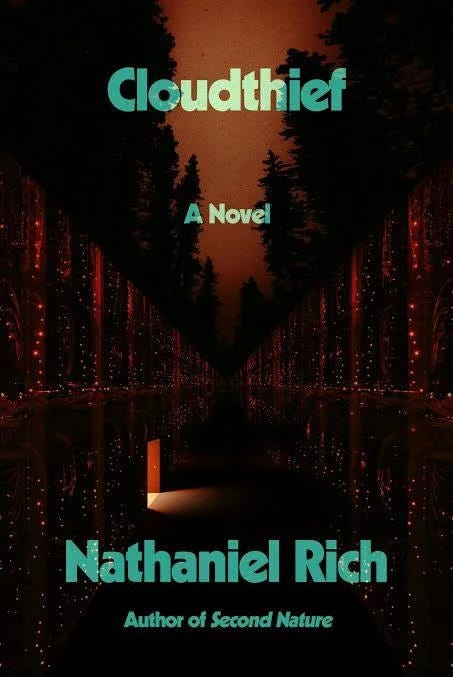
I was not having much luck with my next read, having started and put down at least half a dozen titles before picking up Cloudthief. Once I had started Rich’s book I managed to finish it in three sittings. For me that’s the sign of a good book. It’s not a long book, coming in around 300 pages.
The narrator of the book is a journalist. Writing climate copy for a magazine. He is not just poorly paid, but worn down by the substance of the stories themselves, wildfire, drought, flood, years of writing the same warnings and nothing changing. He now sees what the work does to him, precarity, followed by dread. This is a man on the edge, closer to burnout than poverty. It doesn’t help that former colleagues and activists are taking the green, the green dollar. Working for the businesses they spent years fighting. Is this Rich? Don’t they always say write what you know?
The honest answer is I don’t know. We discover much about the narrator, his father, sister, best friend, his finances, where he lives, but not his name. Aliases, yes. Nicknames. But I don’t recall his real name.
A name is nothing, I assume it’s the one thing most writers settle on quickly. Rich has given his narrator work that mirrors his own but no name. Other characters have names, and you will remember them, Ces, Virginia, Zoe, Rudey and Manny. All named. Precisely. But not our narrator. At one point, back in his own building, he starts to give a neighbour his name, and the sentence is cut off before he can finish it, as if Rich won’t let him have even that.
That missing name is the one part Rich couldn’t, or wouldn’t, hand over. The deniability. You can have my career, parts of my life, but not my name. The reader can’t relax, is this Rich?
This is a clever book. I found it fascinating that Rich had taken his own former life (climate journalism) and given it to his fictional narrator, who in turn takes someone else’s real life story and folds it into his own account, first as metaphor, and later as literal translation work. Véronique Le Guen was a real Frenchwoman who, in the late 1980s, spent months alone in a cave as part of a psychological experiment, and wrote a memoir about the experience. Her book sits on Virginia’s shelf, and travels with the narrator throughout. This is the same act of appropriation happening twice, only at two removes, author to character, character to source text. I liked that.
This is a book about storage. A mini storage centre, the type of place you would have seen on Storage Wars. Data centres, the heart or brain of cloud computing, operated by the likes of (G), (A) and (M). Rich never names the tech giants, but they are so ubiquitous that just a letter gives the game away.
The story starts with a low-stakes burglary. Here we are introduced to Ces and his mini storage breaking-and-entering scam. Ces almost views this as a victimless crime: the storage unit is in a wealthy area, the unit occupier has too much stuff, hence the unit, and will not miss anything. Security is light, the guard’s shift ends before the centre’s night hours begin, the centre is available 24 hours, and Ces knows where the cameras are. He even has a tool that opens the padlocks without breaking them.
One unit doesn’t behave like the others. No padlock, but the gate won’t lift. Ces has a trick for testing whether a locked unit is occupied: he balances a few grains of rice along the top ridge of the gate, then checks later to see if they’ve been disturbed. This time they have. Someone is living inside a storage unit, off the record, deliberately unfindable. This is Virginia.
She isn’t hiding from a debt or an ex, she’s attempting something closer to total erasure, no address, no phone, no traceable name.
The narrator, ostensibly there to interview her for a magazine piece, becomes something else instead. Subject, then lover, then, once the plan moves to Oklahoma, effectively her employee.
The ambition scales up fast. From storage units to something far larger: a data centre, one of the physical buildings that actually houses what everyone calls the Cloud. Rich never names names in the text, initials only, and the narrator even admits, at one point, that he’s changed identifying details, the facility could as easily be an Amazon site in Oregon or a Microsoft one in Iowa as the Google facility it reads as in the book. It hardly matters which. What matters is the kind of building: one most of us never think about, despite it holding a fair portion of our digital lives.
The narrator funds his half of the job the way he’s funded everything else in his career: by pitching it as work. He sells his editor a piece on data centres and their environmental cost, the kind of story he’d have written anyway, and banks the advance. Journalism becomes the alibi for the crime, and, before long, the only story left worth telling.
The plan itself is careful rather than reckless. Rather than pulling live data off working servers, which would trigger every alarm in the building, they go after machines already marked for destruction, decommissioned, awaiting the shredder, and steal them in the gap between disconnection and disposal.
The first real violence comes back at the storage facility, not Oklahoma. A guard catches them mid-act, things turn physical, he’s hurt but survives. Up to this point the book has run largely as comedy, Ces’s schemes, the near-misses in Vinita, the interview at L9X. Here that stops.
Later, in a second and separate confrontation, someone dies. The narrator is arrested, tried in a notably closed, secretive process, and imprisoned.
Everything you’ve been reading turns out to be retrospective. The whole book is a manuscript, written from inside a prison cell, addressed not to us but to one specific person: a child the narrator has never met, Virginia’s child, conceived near the end of the Oklahoma section.
Part III’s register is different from everything before it. Confessional, pleading, aware of its own failures. The narrator admits to not just one earlier draft but several different lengths of the same document sitting in his desk drawer, one running over a thousand pages, another just a few, plus separate versions he says he sent to Virginia, to his sister, and to his father shortly before his father died. He names his own project a kind of self-devouring, the only form left to him now that the story itself is finished.
It changes how the earlier questions sit. An unnamed narrator addressing an unnamed reader is one kind of withholding. An unnamed narrator writing, at enormous length, to exactly one person, who may never read it, is another.
It’s in this same retrospective act, sifting his own story for what he missed at the time, that other details finally cohere. Looking back, you start noticing him. A man on a train. A napping figure on a park bench near the data centre. A beige sedan idling somewhere it shouldn’t be. A stranger who walks past a violent struggle in the storage facility’s lobby without so much as glancing at it. None of it registers at the time, each sighting isolated, forgettable, exactly the way surveillance is supposed to feel: like nothing at all.
From prison, piecing it together, the narrator settles on who it must have been. Virginia’s estranged father, the same man behind the surveillance-based business empire mentioned earlier, the one that made its money from young people livestreaming every private moment of their lives for rent. He’d been there the whole time. When the narrator’s own apartment is ransacked and nothing of value taken, he understands it only in hindsight: not a robbery, a search. The father wasn’t looking for money. He was looking for proof of what his daughter had done.
This isn’t a smaller story than the one about the data centre. It’s the same story at human scale. A man who built an empire on watching strangers, monetising their most private moments, ends up needing none of that machinery to track his own daughter. A licence plate, a reverse lookup, the tools available to anyone with patience and no scruples. The book spends two hundred pages telling you a nation’s worth of secrets sits behind a fence in Oklahoma, guarded by whoever a contractor could find on minimum wage. Then it shows you one man, alone, off the books, doing to his own child what governments and corporations do to everyone. The political argument doesn’t get quieter here. It gets a face.
The narrator’s manuscript, the one you’ve been reading, exists because his lawyers have told him early release depends on a “supportive family member” willing to sponsor his reintegration. The child he’s spent years writing to, now an adult, has so far declined.
I finished the book unsure if I was supposed to feel sorry for the narrator. That may say as much about how I read as it does about the book, I don’t always catch the signposts a text puts up for feeling. What I am sure of is the argument underneath the feeling: a man who spent the whole book taking, storage units, data, another author’s real suffering, a lab assistant’s cooperation at knifepoint, ends it asking for the one thing he can’t take. Whether that’s the book’s verdict on him, or just a softer kind of ending than he’s earned, I still don’t know.
* Copy edited using Claude.
Thanks for reading Anti-Capitalist Musings. It is a small operation, and I hope it offers something worth your time. There will be no premium subscriber content here: everything published will remain free to read. If you value these pieces and want to support the writing, buying me a coffee helps fund media subscriptions and the books that keep the analysis grounded. Every contribution, however modest, is genuinely appreciated.