
Building the State Before Winning It
Rupert Lowe's Restore Britain is not a protest movement. It is a parallel governing architecture under construction.

Restore Britain has produced a 113-page policy paper titled “Mass Deportations: Legitimacy, Legality, and Logistics.” It proposes to deport every illegal immigrant in Britain within three years. The document is not rhetoric. It is an operational blueprint: detention facility specifications, biometric surveillance systems, legal workarounds, diplomatic coercion mechanisms, costings. The authors have thought through how to override judicial review, how to pressure recalcitrant countries, how to convert RAF bases into holding centres, how to incentivise neighbours to inform on neighbours.
This should determine how we understand Rupert Lowe's new party. Not the dilapidated theatre on Great Yarmouth’s pier where he launched it. Not the foot-stamping crowds or Elon Musk’s endorsement or the ethnonationalist influencers declaring him “our leader.” Those details matter, but they are surface. The policy infrastructure beneath them is what distinguishes this moment from previous far-right false dawns.
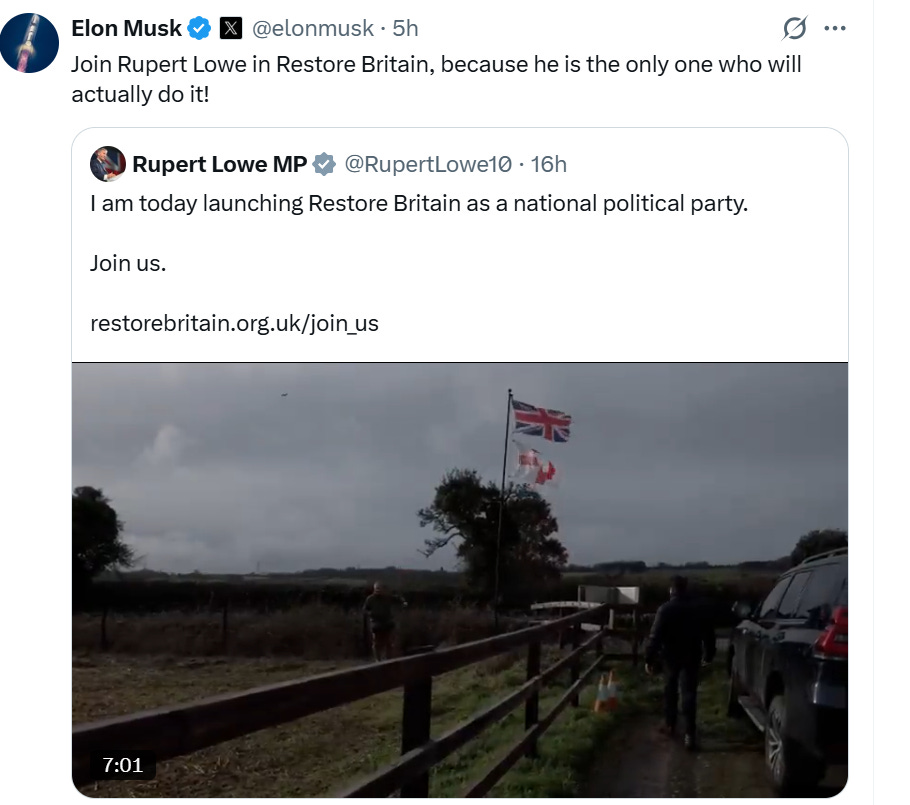
British fascism has historically failed for three reasons: lack of money, lack of media access, lack of institutional capacity. Restore Britain is an attempt to solve all three simultaneously. Musk provides amplification. The “Cromwell Club” donor tier provides funding. And the policy papers provide something previous movements never had: a detailed administrative programme ready for implementation.
The programme as political form
The mass deportations document runs to 113 pages. It is co-authored by Harrison Pitt, a “Senior Policy Fellow” at Restore Britain and contributor to The European Conservative, and Lowe himself. The acknowledgements thank figures spanning media, academia, and law, including anonymous “luminaries at Cambridge, Oxford, and the Inns of Court.”
The legal section calls for withdrawal from the European Convention on Human Rights, repeal of the Human Rights Act, and passage of a “Great Clarification Act” enabling Parliament to override judicial decisions by simple majority. The paper proposes to retain only a “small sliver” of ECHR case law relevant to Northern Ireland’s sectarian balance while stripping everything else. It envisions a “Deportation NATO”: a coalition of Western nations coordinating visa sanctions, aid suspensions, tariffs, and remittance taxes against countries that refuse to accept deportees.
The operational section proposes expanding detention capacity from 2,200 beds to 15,000 by converting former RAF bases. It calls for mandatory biometric checks for bank accounts, NHS registration, and employment. It advocates facial recognition for food delivery drivers and a public reporting system with cash rewards: £500 for information leading to deportation, £2,500 for dismantling an “organised illegal operation.” The paper calculates total costs at £49 to £57.6 billion over five years, offset by projected savings of £12.5 billion annually.
The document reads like a white paper drafted in anticipation of power. It cites the Trump administration’s deportation operations, Australia’s offshore processing, Denmark’s Rwanda negotiations, Italy’s Albania deal. It quotes Home Office statistics and engages seriously with legal obstacles. One section walks through the mechanics of overriding a hypothetical Supreme Court injunction. Another models the diplomatic pressure required to force Pakistan to accept deportation flights.
Three systems under construction
The broader policy platform published on Restore Britain’s website reveals three interlocking systems:
State surveillance and enforcement. Biometric ID requirements for non-citizens. Facial recognition. Mandatory reporting obligations for employers, landlords, banks, NHS trusts. Immigration officers embedded in local councils. Cash rewards for informants. “Tent-based holding facilities.” Retrospective revocation of asylum grants to anyone who arrived illegally since 2018.
Cultural exclusion and identity policing. Banning halal and kosher slaughter. Outlawing the burqa and hijab in public. Making Sharia courts illegal. Banning cousin marriage. Stripping citizenship from dual nationals who “protected rape gang offenders in their family.” Removing “anti-British” academics from universities. Abolishing postal voting.
Donor-capital alignment. Scrapping inheritance tax. Setting corporation tax as the lowest in Europe. Taxing remittances at 25%. Reserving social benefits “for Brits only.” The “Cromwell Club” tier for high-level donors offering exclusive events and an annual dinner.
What holds this together is not ideology in the usual sense. The surveillance apparatus serves enforcement. The cultural programme defines who belongs. The economic policies keep the donors happy. Whether the people drafting this have thought through how facial recognition for Deliveroo riders connects to banning cousin marriage is beside the point. The package exists. It can be implemented piecemeal or wholesale depending on political conditions.
The organisational form
Restore Britain operates through what it calls “direct democracy.” Members pay £20 annually to vote on policy ratification. The FAQ notes that policies containing “anything that brings Restore Britain into disrepute” will not be published, with the leadership deciding what qualifies. High-level donors join the Cromwell Club.
The decentralised structure (local “X First” parties under a national umbrella) is designed to absorb existing networks. Great Yarmouth First is the pilot. Others will follow. Advance UK, led by former Reform deputy leader Ben Habib, has indicated interest in merger. Habib has put £100,000 into his party and claims £600,000 from other sources. Advance has cultivated street protest capabilities that Reform never developed.
The potential combination: Lowe’s parliamentary platform, Musk’s amplification, Habib’s funding, Advance’s ground troops, the policy papers’ administrative architecture. Whether this coalition holds is another question. Habib and Lowe have egos. The street-protest wing and the think-tank wing want different things. Farage has absorbed rivals before.
But the infrastructure is being assembled regardless of whether these particular figures remain at the centre of it.
Who has arrived
Searchlight magazine reports that Lowe’s announcement drew coordinated responses from figures in the organised Nazi milieu. Steve Laws, who spoke recently at a rally organised by Patriotic Alternative, tweeted: “RUPERT LOWE IS OUR LEADER. GET IN LINE.” Sean Wilkes compared Lowe to Ian Smith, the Rhodesian leader who declared unilateral independence to preserve white minority rule.
The divisions within the far right are instructive. Nick Griffin dismissed Lowe as a vote-splitter. Alek Yerbury called Restore Britain “Thatcher on steroids” and noted Lowe’s support for Israel. These are disagreements over strategy and ideology, not fundamental opposition to the programme.
The more significant dynamic is mainstream absorption. Lowe’s “grooming gangs inquiry” attracted Conservative MPs including Nick Timothy, Esther McVey, and Gavin Williamson. It was a self-styled affair with no official standing, but it generated coverage and positioned Lowe as addressing topics the establishment avoids. The pattern: create events that draw mainstream figures, lending legitimacy while pushing the conversation rightward.
The structural moment
Reform UK is vulnerable. Farage built his party as a company, not a membership organisation. This worked during the insurgent phase. It works less well now that Reform holds seats and must govern. Kent exposed dysfunction. Farage’s repositioning towards respectability (Davos invitations, distance from hard rhetoric) has opened space on his right.
The activists flocking to Lowe are not interested in Farage’s pivot. They watched him soften on deportation numbers.
Musk functions as accelerant, not engine. His amplification matters. But focus on him as puppet-master misses the distributed system under construction: the policy production, the donor tiers, the organisational networks absorbing each other, the institutional rot that makes this politics viable in the first place.
The first snap poll to include Restore Britain, conducted by Find Out Now, put the party at 10 per cent with Reform dropping to 25. One poll, small sample, methodological questions. But it points toward something real: the right-wing vote fragmenting in ways that could reshape the conversation even if Restore Britain wins nothing.
Consider what happens in a constituency like Great Grimsby, where Reform took 41 per cent in 2024. A party running to their right does not need to win. It needs to take enough votes to make Reform’s majority uncertain. That changes candidate selection, policy emphasis, coalition arithmetic. The baseline shifts before anyone casts a ballot.

The danger, precisely stated
In 2024, 46 parliamentary seats were won with margins under 2 per cent. A party capable of shaving points from Reform can determine outcomes without winning seats. More importantly, it can reset the terms of debate. The mass deportations paper, with its detailed costings and legal architecture, is designed to make its proposals appear technical rather than radical: problems to be solved, not norms to be violated.
The danger is not that Lowe becomes Prime Minister. The danger is normalisation. Reform must prove it is sufficiently hard-line. The Conservatives must demonstrate seriousness on immigration. Labour must show it is not soft. Each adjustment moves the baseline.
What previous far-right movements lacked, this one is building: money (Musk, Cromwell Club, Habib), media (X, direct distribution), organisation (Advance UK, local parties, street networks), and intellectual infrastructure (the policy papers, the legal analysis, the administrative detail). The constraints that limited British fascism are being systematically addressed.
The 113-page document proposes withdrawing from human rights frameworks, overriding courts by parliamentary majority, revoking asylum retrospectively, detaining populations in converted military facilities, and coercing foreign governments through coordinated economic pressure. The authors describe this as “just a start” in a “wider struggle to restore Britain.”
State-building. Before the state is won.
The question is whether the political system treats this as a legitimate participant or a threat requiring confrontation. That decision, made through coverage choices, platform access, and coalition negotiations over the coming months, will determine what becomes possible.
Lowe himself may be a placeholder. The infrastructure is not.
Against capital, against empire, against forgetting.
Notes and essays from the wreckage of the present.
This the same fuckwit that reported charity rowers as "illegal migrants"?
https://www.bbc.co.uk/news/articles/cdd32lnq445o
Splitting Reform's xenophobic vote will help the Greens.
And anyway their migration policies are economic suicide given that deaths now outstrip births in the UK: we have an aging population that absolutely needs migrant labour to keep things going.