
Cleaning the Stables
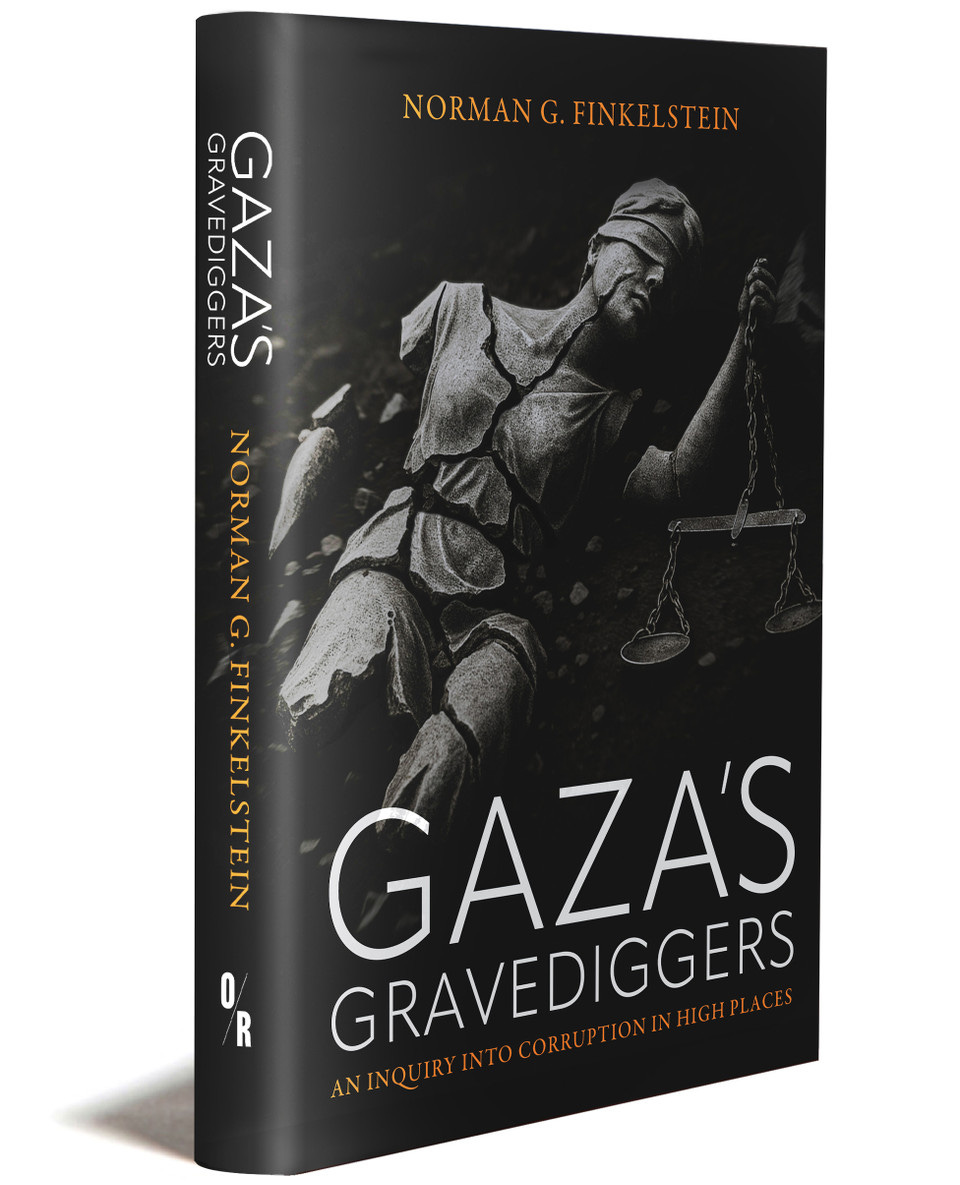
Gaza’s Gravediggers: An Inquiry into Corruption in High Places by Norman G. Finkelstein (OR Books, 2026)

Thanks for reading Anti-Capitalist Musings. It is a small operation, and I hope it offers something worth your time. There will be no premium subscriber content here: everything published will remain free to read. If you value these pieces and want to support the writing, buying me a coffee helps fund media subscriptions and the books that keep the analysis grounded. Every contribution, however modest, is genuinely appreciated.
Finkelstein opens with Hercules. The dedication page gives over the fifth labour, in which Eurystheus orders the hero to clean the stables of King Augeas, thirty years of dung cleared in a single day by diverting two rivers through them. It is a strange, grand image to hang over a book about United Nations procedure, and it tells you most of what you need to know about the temperament behind it. The gravediggers of the title are not the soldiers who levelled Gaza. They are the officials who handled the record afterwards: a special representative on sexual violence, a commission of inquiry, two judges of the International Court of Justice, a former chief prosecutor of the ICC. The filth to be sluiced out is theirs. The rivers are his footnotes.
You do not arrive at a book like this by accident. Four hundred and forty-eight pages of document analysis, dense with comparative tables and citations running to the foot of nearly every page, are not written for the unpersuaded, and they are not read by them either. Finkelstein’s readers already accept that Israel has committed genocide in Gaza. They already distrust the bodies that failed to stop it. They already suspect there is a gap between what those bodies found and what they were prepared to say out loud. Which makes the first serious question about Gaza’s Gravediggers not whether it is right. It is right, and the people who will buy it know that before they open it. The question is what work a book like this can do, and on whom.
The case for the prosecution is, on its own terms, close to unanswerable. Take the opening chapter, on the allegation that Hamas weaponised rape as a tactic on 7 October. The report that became the evidentiary spine of that claim was produced by Pramila Patten, the UN’s special representative on sexual violence in conflict, after a mission to Israel in early 2024. Her own press release stated that the mission was “neither intended nor mandated to be investigative in nature.” The report then proceeded to issue findings, to claim it had “verified” acts of rape, and to weigh the evidentiary thresholds a court would recognise. Finkelstein puts the contradiction without ornament. If the mission was not an investigation, how did it know whose voice to give voice to, and how did it know it had verified anything.
What follows is method applied with a kind of patience that becomes its own argument. Patten, then the Commission of Inquiry chaired by Navi Pillay, then Human Rights Watch, then Amnesty, then the Israeli government’s own Dinah Project: each is held to the standard it set for itself, and in each case the distance between the standard and the finding turns out to be enormous. Human Rights Watch documented no corroborated rape. Pillay’s commission conceded the absence of forensic evidence, conceded it had met no survivor of sexual violence from 7 October, and concluded on “reasonable grounds” that rape had occurred anyway. The reader is shown the mission that reviewed “over 5,000 photos, around 50 hours” of footage and could not isolate a single image of the systematic atrocity it was convened to confirm. As a claim about organised Hamas policy, the rape narrative does not survive the chapter. Whether the chapter should sound quite so pleased with itself is a separate matter, and I will come back to it, because the tone is where this book is most vulnerable.
The second chapter is the one that will last. Here Finkelstein argues that the Pillay commission made a category error: it applied the framework of the laws of war to something that had structurally outgrown it. The laws of war presuppose a war. They assume two armed parties, combatants, proportionality as a calculation that means something. A genocide is not a war conducted badly. It targets a population as such, and the destruction of civilian life is not the regrettable byproduct of the campaign but its content. This is why, as Finkelstein shows by quoting the commission against itself, its incident-level findings kept hunting for a legitimate military target while its pattern-level findings described the methodical erasure of the conditions of life. Raul Hilberg, he reminds us, called his great work The Destruction of the European Jews, not The War Against them. The point is not pedantic. A book that accepts the grammar of “war crimes” has already conceded that a war was being fought.
I find this persuasive, and I think it is the most useful thing in the book. I also think it contains the seed of its own undoing, and Finkelstein half-buries the evidence. Late in the chapter he concedes that Israel’s “overarching, strategic objective was not to annihilate but rather to ethnically cleanse” Gaza, and rescues the word genocide through a footnote arguing that destruction pursued as a means to expulsion is still destruction “as such.” The footnote is correct in law. But it quietly dismantles the clean opposition, annihilation against war, that the chapter was built to defend. The more interesting book, the one flickering underneath, describes a genocide whose proximate aim was expulsion with total annihilation held in reserve. He reaches that book and steps back from it, and a reader who is paying attention notices the retreat.
By the third chapter the temperature rises and the control slips. Most of it is given to Judge Julia Sebutinde of Uganda, the only member of the Court to dissent at every stage of the South Africa proceedings. Her opinions reproduce Israeli pleadings, ignore contrary evidence without acknowledging it, and grow less coherent with each successive order. Finkelstein establishes, in an appendix that does real forensic work, that passages of her July 2024 dissent were plagiarised: an identical passage appears in two separate paragraphs, the hyperlinks from a lifted Wikipedia entry were left embedded in the text, and her sole authority on ancient Israel turns out to have been laundered through a Ugandan op-ed citing a 1968 volume available only in Hebrew. This is documented and damaging and ought to be the chapter. Instead, the chapter is titled “Free Agent or Foreign Agent?” and asks, in plain language, whether Sebutinde was bribed or blackmailed. The plagiarism he proves. The corruption he insinuates, while loading every cue toward the answer he wants, including a parenthetical sneer about her “overpaid” imagination. A careful reader watches him slide from a charge he can stand up, she copied, to one he cannot, she was bought, and the slide costs him. The honest finding, that a judge produced an incompetent and plagiarised dissent sourced from hasbara, is damning enough. He did not need the rest, and the rest is what a hostile reviewer will quote.
There is a deeper problem behind all of this, and it is not Finkelstein’s tone but his theory of the institutions he is flaying. The book proceeds as though the failure on display is one of nerve. It reads as though the human rights bodies and the courts could have stopped the thing, if only they had applied their own procedures with sufficient rigour and courage. Behind every chapter sits a harder question he does not quite ask. Were these institutions ever designed to constrain a genocide backed by the United States? The veto exists. The machinery by which Washington shields Israel at every multilateral forum is documented, durable and entirely deliberate. Finkelstein knows this better than almost anyone alive; he has been writing it for forty years. Yet the architecture of Gaza’s Gravediggers treats American power as the weather rather than the design, an atmosphere in which honest officials might still have done their jobs, rather than the load-bearing structure that determines what those jobs were ever going to be permitted to produce.
His own Final Postscript demolishes the premise he has been working under. On 17 November 2025 the Security Council passed Resolution 2803 by thirteen votes to zero, imposing a ceasefire and a future for Gaza built on what it called “President Donald J. Trump’s Comprehensive Plan.” Finkelstein reads it as an act of legal arson. The resolution did not fail to uphold the accumulated law on occupied Palestinian territory. It erased it, made no mention of occupation, and handed the territory to a Board of Peace chaired, the annex cheerfully confirms, by Trump himself. The comparison Finkelstein reaches for is the Berlin Conference and Leopold’s title to the Congo, which is the strongest analogy in the book precisely because it is structural rather than emotional: a territory deeded as property to one man, accountable to nobody. Then he reaches for Locke, and the register breaks. The Council, having forfeited its legitimacy, has thrust Gaza “into the antechamber of the state of nature,” where the people of Gaza “suffer no obligation to obey this grotesque resolution.” It is the moment the book stops being institutional critique and becomes a verdict on the international order as a whole. It also sits in open contradiction with the four hundred pages that precede it. What those chapters spent their patience trying to prove, that the system failed where it should have functioned, the postscript abolishes in a sentence: by 2803 there is no longer any distinction between institutional failure and institutional design. The corpse, he concludes, answering a phrase Jeffrey Sachs disputed in his own blurb, is the whole body. “After 17 November 2025, the UN is a rotting corpse.”
I want to be careful here, because it would be easy to score the contradiction and move on. The shift from “isolate the rare pockets of corruption” to “the institution is dead” is not necessarily incoherence. It may be the honest record of a position changing under the pressure of an event that arrived while the book was in proof. The trouble is that he does not mark it as a change. The frame and the coda are left to argue with each other on the page, and the reader is the one who has to notice.
Which returns me to the question I started with, and to the thing the book cannot resolve about itself. Accountability work has a long horizon. The archive Finkelstein has assembled will matter when the political conditions that currently make accountability impossible eventually shift, and in that sense the book is a deposit against a future reckoning. Archives have their uses. They do not have strategies. The epilogue knows this, and says so without flinching: “This book was written to expose lies and restore Truth. It will not save lives. The genocide in Gaza is too far gone.” He reaches, finally, for Rousseau, and frames what is left as a “purely spiritual act,” justice pursued for its own sake regardless of result.
The narrowing this represents is not Finkelstein’s alone. It belongs to a tradition. The most serious responses the left has produced to Gaza have taken the form of the legal brief, the commission report, the forensic monograph, and now this book, all of them addressed, explicitly or not, to institutions the same documents prove cannot act. That is not an accident of temperament. It is a statement about where the left, after decades of retreat, still imagines power to lie, or more exactly about where it has stopped imagining it can build any of its own. The alternative to documentation is organisation, and organisation asks for a social base, a theory of power and a willingness to act outside the frameworks that have already failed. Those are harder to assemble than a meticulous record of betrayal. Finkelstein is not the author of that deficit. He is its most eloquent symptom, and Gaza’s Gravediggers is the most exacting account we are likely to get of how the high officials of the international order behaved while a people was destroyed in front of them. What it cannot tell us, because nobody can yet, is whether anyone will ever be in a position to use it.
Thank you to OR Books for the advance proof copy.
Thanks for reading Anti-Capitalist Musings. It is a small operation, and I hope it offers something worth your time. There will be no premium subscriber content here: everything published will remain free to read. If you value these pieces and want to support the writing, buying me a coffee helps fund media subscriptions and the books that keep the analysis grounded. Every contribution, however modest, is genuinely appreciated.
How can Bensouda AND ICC "STAFF" have been threatened but Sebutinde was left alone and not Influenced? This review was written before Bensouda spoke up?
Mick Jagger's song "Too Far Gone" from 2000s Goddess In The Doorway has new meaning for me, thanks. I'll pre-order it next month.
A dispassionate, clinical analysis of the book!