
The Accommodation
Why European elites will abandon Ukraine, and how they will pretend they did not

Steve Witkoff, Donald Trump’s special envoy, described Vladimir Putin as a great guy. Super smart. Honest. He takes him at his word.
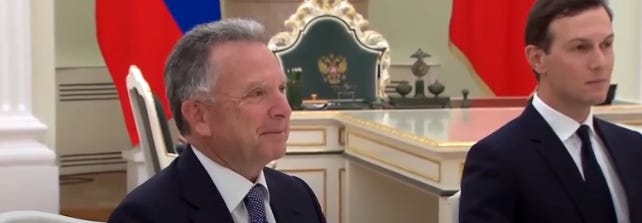
I keep coming back to this. Not because it is outrageous, though it is, but because Witkoff is not lying. He is not performing for the cameras or running some elaborate feint. He means it. He looked at the man who ordered Bucha and saw someone he could do business with, and the thing is, from inside his world, he is not wrong.
Witkoff made his fortune in New York real estate. Property development. A business where contracts mean something because courts enforce them, where handshakes between serious men carry weight, where everyone’s interests are ultimately legible because everyone’s interests are ultimately the same. More money. More property. More leverage for the next deal. He looks at Putin and sees another developer across a negotiating table. Crimea as an opening bid. Donetsk as a negotiating position. Everything has a price. You just need to find the number.
This is not stupidity. It is something worse. It is the authentic worldview of a class that has never had to defend anything because ownership was always guaranteed by someone else. By laws. By institutions. By the quiet threat of American power underwriting the whole arrangement. Witkoff has never had to consider what happens when the man across the table does not want a deal. When he wants the table. When he wants the room the table is in and the building around it and will keep taking until someone stops him.
European leaders understand this, or claim to. They issue statements about imperialist intentions, destabilising powers, state-sponsored terrorism. The EU’s top diplomat says the words. The French and Germans warn that Putin’s ambitions extend to NATO itself. They are not wrong.
They are also completely ineffective.
Today the European Commission unveiled its plan to use frozen Russian assets to fund Ukraine. Today Belgium rejected it.
This is not next week. This is not the summit on 18 December. This is today, 3 December 2025, as I write this. Von der Leyen presented her proposal. Ninety billion euros backed by the frozen Russian assets sitting in Euroclear. Belgium’s foreign minister, Maxime Prévot, stood at NATO headquarters in Brussels and called it “the worst of all” options. Too risky. Never been done before.
“We are not seeking to antagonise our partners or Ukraine,” Prévot said, haltingly reading prepared remarks. “We are simply seeking to avoid potential disastrous consequences for a member state that is being asked to show solidarity without being offered the same solidarity in return.”
Read that again. A member state being asked to show solidarity. Without being offered the same solidarity in return.
One hundred and ninety-four billion euros sitting in a Brussels clearinghouse. Ukraine’s budget runs dry in April. And Belgium will not act because Euroclear might sue. Because it has never been done before. Because risk must be shared, and no one wants to share it, and so nothing happens.
Here is what makes it worse. In May this year, Euroclear found a way to release three billion euros from those same frozen Russian holdings. Not to Ukraine. To Western investors who had lost money when Moscow confiscated their assets in retaliation for sanctions. When European banks needed compensating, the legal creativity flowed. When Ukraine needed defending, Belgium demanded ironclad guarantees.
Von der Leyen assured everyone the burden would be distributed fairly. “As it is the European way.”
The European way. I am writing this piece and they are providing the examples faster than I can type them.
I have been trying to write this piece for days and the problem is that the conclusion is obvious, has been obvious for months, and stating it feels redundant. Everyone paying attention already knows. European elites will find an accommodation with Russia. They will abandon Ukraine in substance while claiming to defend it in principle. The whole thing will be dressed up as realism, diplomatic maturity, the wisdom of knowing when to cut your losses.
This is not a prediction. It is a description of what is already happening.
But you cannot say this. Not in the places where it might matter. Not in the papers that brief politicians or the think tanks that shape policy or the comment pages that define the boundaries of acceptable opinion. There you must maintain the fiction that the outcome remains open, that vigorous debate might yet shift the trajectory, that European leaders face a genuine choice between confrontation and capitulation rather than a managed transition from one to the other.
So I am saying it here, in this article that reaches nobody who matters. Europe is going to lose this confrontation with Russia. Not because Russia is militarily stronger. NATO would win a conventional war and everyone knows it, including Putin. Europe is going to lose because its political class does not believe in anything worth the cost of winning. They believe in their positions. Their pensions. Their property portfolios. The school fees. The holiday home. The retirement plan.
They will talk tough until talking tough starts to cost them.
The thing about forty years of managed decline is that it trains you. It teaches you what is possible and what is not. What can be defended and what must be sacrificed. You learn to treat each defeat as inevitable, each accommodation as realism, each surrender as maturity. The factory closes: nothing to be done, the market has spoken. The hospital is privatised: unfortunate but necessary, there was no alternative. The trains do not run, the schools crumble, the high street dies, the futures narrow, and at every stage you are assured by serious people that this was the only responsible course. That those who wanted to fight were naive about how the world works. That adults understand the need for difficult choices.
Now the same people, the same class, the same formation that could not defend a bus route or a library or a steelworks, are going to defend the European security order against a revanchist nuclear power.
Pull the other one.
I do not say this with satisfaction. I am not scoring points. I am trying to describe a dynamic that seems to me inescapable given everything we have watched these people do for the past four decades. They did not defend public services. They did not defend industrial capacity. They did not defend wages, conditions, housing, the possibility of a dignified life for people who work. Why would they defend Ukraine?
Listen to how they talk about rearmament. Germany is experiencing a defence-industrial boom. Unprecedented orders. Production lines humming. So how is it framed? Economic stimulus. A solution to sluggish growth. Job creation in depressed regions. Export opportunities.
Not sacrifice. Never sacrifice. The word does not appear. No one talks about what might be given up, what might be risked, who might have to die. They are approaching the most dangerous confrontation since the Cuban Missile Crisis with the vocabulary of a regional development grant.
NATO’s secretary general calls for five per cent of GDP in defence spending. The figure floats there, abstract, detached from any account of where it would come from. Five per cent is not a small adjustment. It would mean austerity of a kind that would make the 2010s look gentle. Or it would mean taxes that the same politicians have spent their careers promising never to raise. Or it would mean borrowing on a scale that would trigger exactly the bond market panics they have spent decades organising policy to avoid.
None of this is discussed. The number is announced, the gravity is performed, and everyone moves on because everyone knows it is not going to happen. Not at five per cent. Not at four. Probably not even at three, sustained, for the decade it would take to rebuild capacity that was allowed to atrophy because history had ended and there would never be another war.
Putin understands this. His whole strategy depends on it.
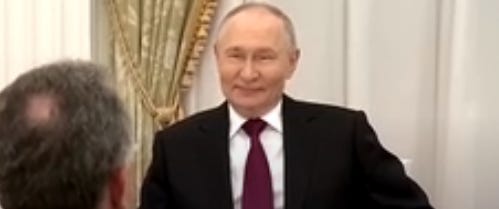
The sources I have been reading make this explicit. Russia’s goal is to “call a halt to the rearmament of Europe.” Not through military victory, which is likely beyond Russian capacity, but through political exhaustion. Putin needs only to simulate a peace process. He needs only to dangle the prospect of a deal, to let European publics believe that the cost of confrontation might be avoided, to give every faction in every country a reason to believe that someone else should bear the burden.
The hard right will say the money should go to borders and deportations. The liberal centre will say diplomacy deserves a chance. Parts of the left will mutter about NATO expansion. Everyone will find reasons why this is not their fight, not their responsibility, not worth the price. And Putin, who is spending forty per cent of his state budget on defence, who has converted his entire economy into a war machine, will wait.
He believes time is on his side. The sources say this repeatedly. He is not wrong.
There is a concept I came across in the research. Strategic neutralisation. It comes from Andriy Zagorodnyuk, who was Ukraine’s defence minister. The idea is that Ukraine cannot win outright and cannot rely on Western support, so it must instead become so costly to attack that Russia cannot sustain the assault. The porcupine model, they call it. Make yourself too painful to swallow.
The Black Sea is the proof of concept. Ukrainian naval drones and missiles did not destroy the Russian fleet but made it ineffective, forced it to withdraw, opened shipping lanes. Not victory but survival. Not triumph but continued existence.
I find this clarifying in a grim way. It is the strategy of a country that has accepted no one is coming to save them. Taiwan is watching this. The Baltics are watching. Everyone who ever structured their security around American guarantees is watching Ukraine learn in real time what abandonment looks like and how you live through it.
But Europe is not learning. Europe is still waiting for America to remember itself. Still drafting communiqués, convening summits, proposing funding mechanisms of baroque complexity designed above all to avoid the appearance of commitment. Belgium worries about legal liability. The European Central Bank warns it cannot act as backstop. Everyone hedges. Everyone preserves optionality. Everyone keeps the path to accommodation open.
Let me tell you what the accommodation will look like. I want to be specific because specificity is the only antidote to the gaslighting that will follow.
Ukraine will be offered security guarantees that are carefully worded to be unenforceable. Phrases like “in consultation with” and “taking into account” and “consistent with the security interests of all parties.” NATO membership will be deferred indefinitely, reframed as a phased process, conditions-based, always receding toward the horizon. The weapons will continue for a while, enough to prevent immediate collapse, not enough to change the trajectory.
Sanctions will be quietly relaxed. Not formally lifted, that would be too obvious. But exceptions will multiply. Enforcement will slacken. European companies will find ways to resume trade that everyone agrees not to look at too closely. The frozen Russian assets, all two hundred ninety billion of them, will remain frozen but unused. A permanent limbo. Not seized, because that would set a precedent. Not returned, because that would be surrender. Just sitting there, a monument to the inability to commit.
European leaders will give speeches. They will speak of realistic diplomacy, the dangers of maximalism, the need to accept imperfect outcomes in an imperfect world. They will warn that critics do not understand complexity. They will suggest, more in sorrow than anger, that those demanding stronger action are naive about how international relations work. About how the world is. About the price of idealism.
Within five years the same voices will call for normalisation. Energy security. Strategic balance. European industry needs markets. Needs gas. Needs to be pragmatic about these things. Russia is a fact of geography. We must deal with the world as it is, not as we wish it to be.
I keep asking myself if I am being unfair. If there is some version of events where European leaders rise to the moment, where the defence spending materialises, where the political will coheres, where Putin’s calculation proves wrong.
I just cannot see it.
Not because the people are incapable. Not because there is something essentially craven about European civilisation. But because the entire structure of European political economy for the past forty years has been optimised for exactly the opposite of what this moment requires. The politicians have been selected for their ability to manage decline, not resist it. The institutions have been designed to prevent state action, not enable it. The publics have been trained to accept necessity, not demand alternatives.
You do not rebuild that in a year. You do not rebuild it in five. Maybe you do not rebuild it at all. Maybe the capacity for collective action at that scale has been so thoroughly dismantled that it simply is not available, regardless of how many urgent summits are convened or how many solemn declarations are issued.
The Czech general had it right. If Article 5 is tested and fails, it is the end of NATO. But the thing is, everyone knows it would fail. That is why it will not be tested. That is why the accommodation will come. Not because anyone decides to abandon Ukraine but because no one decides not to, and the drift continues, and one day we wake up and the thing has happened while everyone was waiting for someone else to act.
There is no call to action here. I am not going to pretend there is something you can do, some lever you can pull, some protest that will shift the trajectory. The structural conditions that produced this outcome are not amenable to individual intervention. The political class that will negotiate the accommodation is the only political class on offer. The institutions that will ratify it are the only institutions we have.
What remains is clarity. The accommodation will come. It will be dressed as wisdom. Knowing this in advance does not change anything but it does inoculate, a little, against the gaslighting that will follow.
When they tell you this was the only realistic option, you will know they are lying. When they tell you European values have been preserved, you will know what was actually preserved: property, position, the ability of a certain class to keep crediting itself with seriousness while presiding over the liquidation of everything it claims to defend.
When they tell you this is peace, you will know what kind of peace it is.
I'll echo Cryn on that being a grim read with realism.
While there are very few inevitabilities, a capitulation by European leaders is absolutely plausible. Not as you say because they don't have options but from other limitations.
https://challengerresearch.substack.com/p/dispelling-6-european-defence-myths
They're not a homogenous group but the exceptions at the fringes tend not to be in Ukraine's favour.
I do think there is an avenue for avoiding the disastrous outcome you describe, despite lukewarm European aid and a US busy turning into a Russian ally/puppet.
https://billemmott.substack.com/p/a-declaration-of-political-war
That avenue is that Ukrainians can plausibly outlast the Russian state.
https://dichebach.substack.com/p/ukraines-social-cohesion-and-battlefield
https://theeasternborder.substack.com/p/17-russian-civil-war-20-is-inevitable
https://siliconcurtain.substack.com/p/russia-facing-civil-war
https://professorbonk.substack.com/p/the-ledger-that-could-break-putins
https://roguesystemsrecon.substack.com/p/ukraines-ultimate-triumph-taking
A grim, but realistic look at what's to come for Ukraine, Simon. We must see capitulation in its entirety, despite what European politicians try to shove down our throats. This essay prepares one for that and explains why Putin is winning. It's sickening.