
The Bought Men
How the American security state recruited its own lumpenproletariat.

I used to think the second Trump presidency would lean on the Proud Boys, the Oath Keepers, and the wider militia world. It felt obvious. They were visible, loud, hungry for purpose, and ready for a fight. They had become the shock troops of a movement that believed the country belonged to them alone. After January 6th it was natural to see them as the vanguard of whatever came next.
I should have known better.
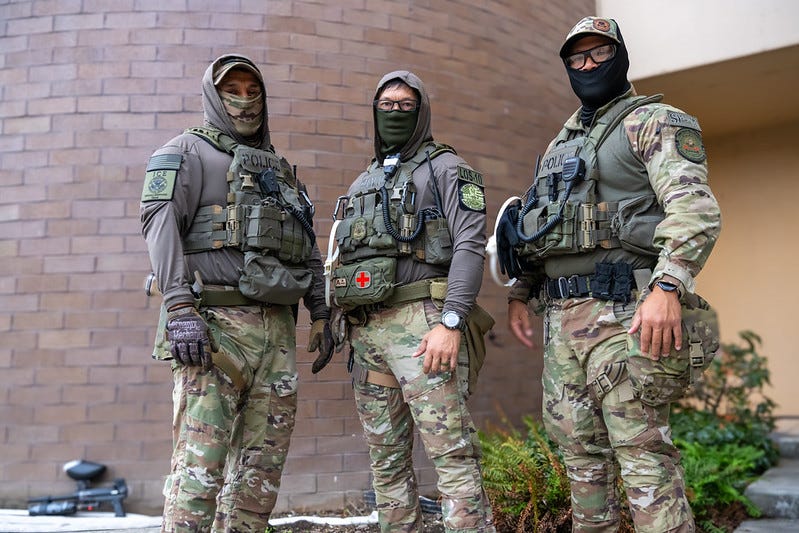
The real enforcement arm of Trump’s second term did not come from the men who stormed the Capitol. It came from the men who carry federal badges and government pensions. The Department of Homeland Security, and within it ICE and Border Patrol, now functions as the closest thing the administration has to a private security force.
America has always had this capacity. Sometimes it hides it. Sometimes it flaunts it. The Palmer Raids rounded up thousands of suspected radicals and deported hundreds with barely a hearing. A. Mitchell Palmer hoped the crackdown would carry him to the White House. The raids were his audition. They succeeded until they didn’t. The machinery remained.
Then Hoover. A half century in which the FBI treated dissent as sedition and protest as insurgency. COINTELPRO infiltrated, disrupted, and in some cases killed. The Black Panthers. The anti-war movement. Civil rights organisers. Everything was classified and deniable. When it finally leaked, there were inquiries, promises of reform, and the usual vows that it would never happen again. The vows lasted until the next excuse. They always do.
September 11th supplied the excuse.
The War on Terror did not create a new apparatus. It revived an old one.
It wrapped the revival in national security language and placed it beyond ordinary scrutiny. DHS was the bureaucratic expression of that revival. Since its creation it has developed paramilitary units, opaque chains of command, and a culture shaped by counterinsurgency doctrine. Oversight was weak from the start. Discretion was huge. Every year stretched the remit further. Each stretch came with a justification. The justifications accumulated into something unrecognisable.
By the time Trump first arrived in Washington, the system was already humming. He did not build it. He walked into a room where the lights were on and asked the people inside to turn the dial.
But what kind of people were inside?
The recruitment pools for Border Patrol and ICE were narrow and predictable. Working class, lower middle class, small town, ex-military. People from places the economy abandoned. People who wanted the security of a state salary and the clarity of a world divided into threats and non-threats. The agencies offered structure, a steady wage, and something else. Authority. The power to make others afraid.
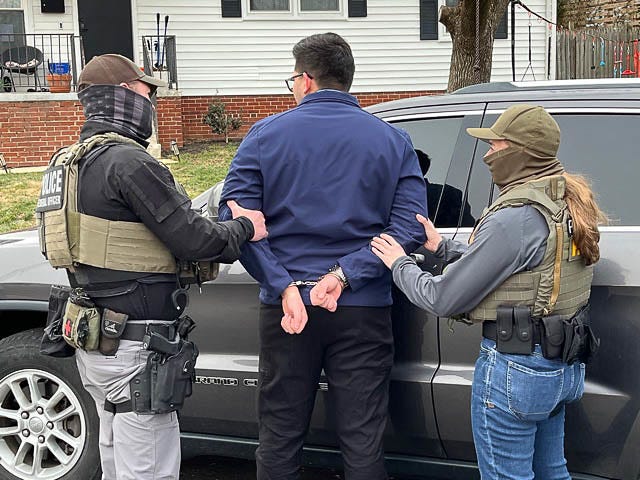
This is an old bargain. The state has always offered it to those it recruits for coercion. You may not rise high but you will not sink low. You will have the badge. You will not be the one the badge targets.
The agencies know this. Their recruitment strategies lean on it. As staffing shortages worsened, standards dropped. Background checks were rushed. Psychological screenings were treated as routine. Predictably, the proportion of agents involved in criminal behaviour rose. Smuggling. Bribery. Domestic violence at rates higher than the national average. Assaults in detention. They reflected the kind of workforce produced by the incentive structure.
Marx used the term lumpenproletariat to describe the declassed layers available for political manipulation. Not the workers but the men who drifted beneath them, who could be hired for any purpose. Louis Bonaparte relied on them to staff his Band of the 10th of December. They were not ideological. They were simply available.
The twenty-first century version has been lifted out of precarity and placed inside the federal security state. Uniforms, pensions, healtcare. A wage entirely dependent on the state’s willingness to pay them for violence.
Their position has no connection to production. They do not make anything.
Their function is enforcement: surveillance, detention, interrogation, removal. The skills are the skills of coercion. The culture rewards aggression. The work offers no craft, no creation, nothing that connects them to the social fabric through labour. Only the power to make others afraid.
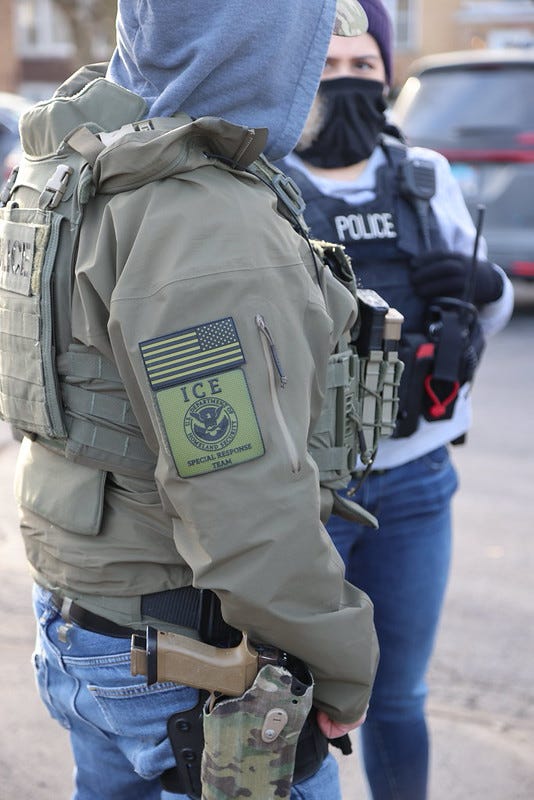
The loyalty this produces is not ideological, though many hold reactionary views. It is material. If the funding dries up, they lose everything. This is why appeals to conscience do not work. Cruelty is not a moral problem for them. It is a job requirement.
Bonaparte understood this. Trump understands it too. When you need enforcers you do not look for the principled. You look for the bought.
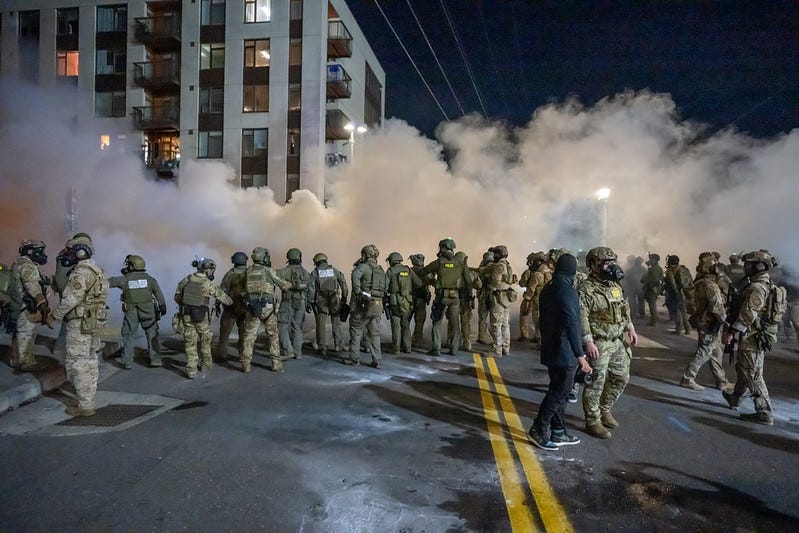
When Trump returned to office, this class fraction found the employer it had always imagined. The remaining restraints came off. He did not need irregulars in the streets. He had men with legal authority to raid houses, stop cars, and separate families. He had a department whose senior staff understood that institutional survival depended on political loyalty. He had an apparatus primed to treat discretion as permission.
Liberals kept obsessing over militia theatrics. Men in tactical vests outside statehouses. Loud threats from fringe groups. They missed the deeper shift. The centre of gravity had moved inside the state itself. Border Patrol had treated its legal boundaries as optional for years. ICE operated with a casual disregard for due process. None of this began with Trump. What he supplied was the political cover that turned practice into posture.
The difference between a movement that fantasises about violence and an agency that possesses the capacity for it is stark. One creates noise. The other creates facts. People who feared a new generation of brownshirts were looking in the wrong direction. Modern authoritarianism does not rely on street gangs. It relies on bureaucracies that have normalised coercion and no longer feel bound by public oversight.
This became visible when DHS began treating political dissent as a security threat.
The killing of Renee Nicole Good revealed what the machinery had become. A legal observer, documented as such, shot three times through her car window in Minneapolis. The footage shows her turning slowly. The car jolts after the first shot. There is a brief silence, then the next two. The officers stand without urgency. The agency’s internal review reads like it was produced in a vacuum. Procedures followed. Protocols observed. An unfortunate outcome.
The gap between the language and the killing is the entire story. Paperwork on one side. A body on the other. One describes an incident. The other records an execution. The institution speaks the language of regret. The video shows a force that expects impunity and has been trained to rely on it.
Good was not an anomaly. The system did not malfunction when it killed her. It functioned. This is what it has become.
Once DHS understood the White House wanted a harder posture, the incentives aligned. More raids. More stops. More armed presence. The staff who had always wanted a freer hand felt vindicated. The staff who once hesitated learned not to.
The assumption that authoritarian politics relies on irregular violence belongs to another era. The contemporary version wears uniforms and carries laminated badges. It writes reports, submits budgets, and treats coercion as an administrative task. A president needs no private militia when the state has already cultivated one for him inside the federal payroll.
In Trump’s second term the militias have become spectators. The real actors are the agencies with legal authority to arrest and detain inside the country. They operate with confidence, political protection, and a sense of mission forged over two decades.
This changes the scale of danger. A militia can frighten a street. A federal agency can reshape the political terrain of an entire nation. When that agency loses contact with democratic restraint, the ground shifts beneath everyone. The first Trump presidency hinted at this possibility. The second has embraced it fully.
The security architecture built after September 11th has turned inward. The tools of counterinsurgency have returned home. The men trained for enemies abroad have been given new enemies within.
I used to think the militias would be the ones to watch. I was wrong. The danger was never in the streets.
The question was once what might happen if a president with authoritarian instincts discovered he did not need unofficial enforcers because the state had already grown its own.
The machinery is now running full tilt. Consent no longer required.
Against capital, against empire, against forgetting.
Notes and essays from the wreckage of the present.
Another great perceptive article Simon. How do you do it? ✊🏽 May be we need to closer to home to see what's happening? That Tommeh Ten Names and the flagshaggers are not the real dangers, but rather what's happenning within the state apparatus and it's criminalisation of any dissent - supported and enabled by this Labour government and previous Tory ones?