
THE DANGER YOU ARE NOT LOOKING AT: Great Yarmouth
Ground Zero: Great Yarmouth, Restore Britain, and the damage that will not be measurable until 2031

Thanks for reading Anti-Capitalist Musings. It is a small operation, and I hope it offers something worth your time. There will be no premium subscriber content here: everything published will remain free to read. If you value these pieces and want to support the writing, buying me a coffee helps fund media subscriptions and the books that keep the analysis grounded. Every contribution, however modest, is genuinely appreciated.
On April 9th, Rupert Lowe posted the same message to Facebook and X simultaneously. “Our full slate of candidates for the May elections has been confirmed across the Great Yarmouth constituency. Then we take Restore Britain national. That’s our plan.”

Eighty thousand impressions on X within hours. The replies were largely celebratory. Most commentary treated it as routine pre-election positioning from a maverick MP consolidating his local base.
It is not routine. For anyone who has been tracking Restore Britain's ideological infrastructure, its European network connections, and its 133-page deportation blueprint, the post reads differently. Great Yarmouth is not Lowe's constituency in the ordinary sense. It is the proof of concept. Win here, scale nationally. The Facebook content posted the same day makes the programme explicit.
Rachel is 31, privately renting a two-bedroom property with mould and water coming through the electric circuits. The local housing team knows about it. They have told her they have nowhere to put her. Walking through the town centre recently, she saw what she took to be Romanians being given flat keys. “What’s going on here?” she asked. She had tried everything, Citizens Advice included. The system had nothing for her. This is reported by Shaun Lowthorpe in UnHerd, a publication whose editorial positioning we will return to. It is worth holding that detail in mind: the ground-level testimony that most directly illustrates the housing crisis underpinning Lowe’s support was gathered by a journalist writing sympathetically about him, for a publication with no particular interest in making the left’s argument.
That testimony is not a story about immigration. It is a story about a housing crisis decades in the making, in a borough that ranks 32nd most income-deprived in England, where a third of its children live in poverty and where the local council has at times feared it might run out of cash. Rachel’s frustration is accurate. Her analysis of its cause has been shaped by something external to her situation. That shaping is not accidental, and it did not happen by itself.
Lowe won Great Yarmouth for Reform UK in July 2024 with a majority of 1,426, pushing the Tories into third. He has since fallen out with Farage and left Reform and launched Restore Britain at Britannia Pier, the same seafront structure where comics still play for laughs at the end of the Golden Mile, in a town that has been losing its economic base since the herring boats stopped coming. Several areas in the borough rank among the most deprived in the country, and local deprivation relative to other areas has been increasing for years. Healthcare, accommodation, food services, and retail employ a greater proportion of residents here than elsewhere in the region or nationally. The offshore oil and gas sector that partially replaced the fishing industry did not distribute its wages evenly. Workers commuting into the borough typically earn more than residents, indicating they are more successful at securing better-paid local jobs requiring higher technical qualifications.
The people structurally excluded from that income are the people Lowe is now addressing.
Great Yarmouth was an early pilot town for contemporary welfare reform in Britain. Research conducted there documents how public services were weakened despite increased need, with welfare cuts falling unevenly on the poorest households. Universal Credit did not arrive in a neutral environment. It arrived in a place already carrying structural unemployment, an ageing population, and a health profile that directly tracks poverty. Between 2011 and 2021, the proportion of residents economically inactive due to long-term sickness or disability rose from 4.9 to 6.1 percent. That rise did not happen because people stopped wanting to work. It happened because illness rates already ran above national averages, because the care infrastructure was being withdrawn at the same time the population was ageing, and because Great Yarmouth recorded one of England’s largest increases in the proportion of residents providing between 20 and 49 hours of unpaid care weekly, absorbing work the state had retreated from.
The housing data tells the same story from a different angle. Private renting rose from 16.5 to 21.5 percent between 2011 and 2021, while social renting fell and home ownership fell. Rachel is renting privately with mould through her electrics because the social housing stock contracted while the private sector expanded into the gap, with no regulatory floor capable of forcing landlords to maintain properties. That is a structural outcome of housing policy running back four decades. Lowe’s programme offers her deportation of Romanians. The mould remains.
The migrant workers she sees around the town centre are, in many cases, bussed in from agricultural and food processing operations more than an hour away, working twelve-hour shifts in chicken factories and packing plants, housed in former seafront guest houses repurposed as houses of multiple occupation. They are not competing with Rachel for social housing through some failure specific to immigration policy. They are there because Bernard Matthews opened recruitment offices in Lisbon in the New Labour era, because freedom of movement extended that pipeline across the Portuguese diaspora in South America, Africa, and Asia, because the agricultural sector requires cheap mobile labour and found a ready supply. The guest houses that once held the coal miners and steel workers who came down from Glasgow every July now hold the people doing the work the food supply chain requires. When they are not on shift, they gather in the town centre because there is nowhere else to go. That is what Rachel sees. The largest non-English-born communities in the 2021 census were Lithuanian at 1.6 percent of the population and Portuguese at 1.5 percent. These are the people whose labour holds parts of the local economy together. One market trader, fourth-generation family business, acknowledged that Polish and Albanian customers represent 70 percent of his trade.
None of this appears in Lowe’s Facebook content. What appears instead is a programme.
Read in sequence, his posts from this week are not a scatter of provocations. They are a scaling document. Foreigners on benefits: deported. Foreigners in social housing: asked to leave, then deported if they refuse. “Indolent Somalian families”: their presence in Britain described as a political choice that a Restore Britain government would reverse. Pakistan: top of the immigration red list, described as having been “proven to disproportionately supply us with rapists, illegals and criminals.” In Great Yarmouth, 94.6 percent of residents identified as White in the 2021 census. Asian, Asian British, or Asian Welsh residents accounted for 1.9 percent of the population. Pakistan does not appear in the top five countries of birth in the constituency. The red list targeting Pakistan is being constructed for a national audience using a Great Yarmouth mandate, in a constituency where Pakistani-born residents are not a measurable demographic presence in the published data. The category of the threatening foreigner has to be kept vivid regardless of local reality. That is the point of it.
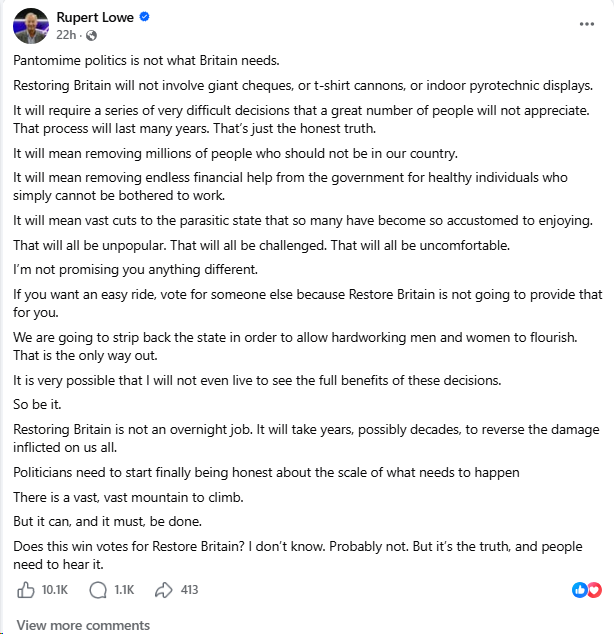
Then there is the "parasitic state" post, which is doing different work from the rest. It is the austerity programme in the register of brutal honesty. Millions of people who "cannot be bothered to work" will lose financial support. The state people have "become accustomed to enjoying" will be stripped back over years, possibly decades. "I am not promising you anything different." The repetition is deliberate. Lowe is performing the long view, the willingness to say what others will not, the seriousness of a man who accepts unpopularity. It is the Milei register: not comfort, truth. The largest employer category in Great Yarmouth is human health and social work. The people working in those services, holding the care infrastructure of a borough with above-average disability and illness rates together, are working in what Lowe describes as the parasitic state. The residents economically inactive due to long-term sickness, whose numbers grew across the austerity decade, are the people whose “endless financial help” he proposes to remove.
There is one further detail worth registering, again from Lowthorpe's reporting. When Lowe stays in the constituency, he is reportedly a guest of Lord Agnew, the former Conservative Treasury and Cabinet Office minister who backed Kemi Badenoch for party leader. Local Conservative sources have floated the possibility of Lowe eventually joining the party. "Reform are not going to take him back," one unnamed Tory councillor told Lowthorpe. "Personally, I would be happy to have a conversation." The man presenting himself as the enemy of the failed establishment parties has a base in its Norfolk wing.
Which returns us to UnHerd. The Lowthorpe piece sits in a publication that has provided a platform for post-liberal conservatism and has published writers broadly sympathetic to the political currents Restore Britain draws from. Its correspondent went to Great Yarmouth looking for evidence that Lowe was connecting with real grievances. He found it. Even so, the material conditions he documented are too stark to be contained by that framing. When a publication with a structural sympathy for this politics cannot avoid recording the deprivation underlying it, the deprivation is not in dispute. What is in dispute is the explanation being offered for it.
Now consider what those conditions will look like in 2031, when the next census is taken.
The median age in Great Yarmouth was 46 in 2021, against 40 for England as a whole. The number of residents aged 65 to 74 rose by nearly 1,900 between 2011 and 2021, while the 35 to 49 cohort fell by around 1,700. By 2031, the cohort that was 55 to 64 in 2021 will be moving into older age brackets. Care demand will be substantially higher. The working-age population providing and funding that care will be proportionally smaller. The unpaid care burden, already among the highest increases in England across the preceding decade, will rise further as formal provision continues to contract.
When Great Yarmouth Borough Council voted unanimously to progress a local plan delivering 4,350 homes over fifteen years to meet government targets, Lowe said he would "fight" to stop it, blaming "uncontrolled mass immigration" for the lack of housing and pressure on local services. The council's cabinet member for economic development responded that without the plan, developers could build 10,000 homes with no local oversight. A Labour councillor noted drily that the town would need more homes if Lowe succeeded in his stated ambition to revive its fishing industry. Private renting in Great Yarmouth rose five percentage points in a single decade. The MP opposing the only mechanism capable of addressing that trajectory did so in the name of immigration control, in a constituency where the housing crisis is structural, four decades in the making, and entirely unrelated to the number of people crossing the Channel.
These are not predictions. They are existing trends, already measured, already moving. The 2031 census will not record desperation as a category. It will record its indicators: sickness, inactivity, private renting, unpaid care, children in poverty. Every single one of those indicators was already moving in the wrong direction before Lowe was elected. His programme accelerates every trend while directing the anger those trends produce at the people least responsible for them. The Lithuanian workers in the packing plants. The Portuguese families in the former guest houses. The Somalian families whose presence in Britain is described as a political choice requiring reversal.
Great Yarmouth did not vote for remigration. It voted against being left behind. Lowe is preparing to use that vote as the foundation of a national project that would deepen the abandonment it was meant to protest, and the next time anyone will be able to measure the damage properly is a decade away.
Thanks for reading Anti-Capitalist Musings. It is a small operation, and I hope it offers something worth your time. There will be no premium subscriber content here: everything published will remain free to read. If you value these pieces and want to support the writing, buying me a coffee helps fund media subscriptions and the books that keep the analysis grounded. Every contribution, however modest, is genuinely appreciated.