
The Family Silver
Thames Water’s creditors are preparing to sue an incoming prime minister. He does not need to fight them. He needs to stop rescuing them

Thanks for reading Anti-Capitalist Musings. It is a small operation, and I hope it offers something worth your time. There will be no premium subscriber content here: everything published will remain free to read. If you value these pieces and want to support the writing, buying me a coffee helps fund media subscriptions and the books that keep the analysis grounded. Every contribution, however modest, is genuinely appreciated.
Pallas Partners is a litigation firm. Its latest clients hold most of the debt of Britain’s largest water company, and the case they are preparing is against a prime minister who has barely entered Number Ten. Apollo Global Management, Elliott Management, Farallon Capital and Silver Point Capital, the funds behind the London and Valley Water consortium, hold £17 billion of Thames Water’s £21 billion debt. They have spent months negotiating a £10 billion restructuring that would hand them control of the company. Ministers rejected the last version because too much of the cost would have fallen on customers. Now Andy Burnham has arrived in office saying plainly that Thames should pass into public ownership, and the creditors have retained lawyers to fight the elected government of the country whose water they control.
This is where water privatisation has ended up. Distressed-debt funds, mostly American, are preparing to litigate against a democratic mandate over the supply of water to sixteen million people. Thames Water’s annual report, published last week, admits that the company has enough money to survive only until the end of the year. The business is broken. What the lawyers will defend is the creditors’ right to be paid before the public is allowed to repair it.
This week I went back to Kenneth Baker’s memoir, The Turbulent Years, published in 1993. The preface is printed on paper that has aged to the colour of weak tea. Beneath an epigraph from Samuel Johnson about disentangling confusion, Baker runs through his achievements: British Telecom sold, the GLC abolished, the education acts forced past the vested interests, Britain’s frontiers defended against Brussels. It is the long 1980s reduced to a page, written by a man who helped make the decade and never acquired much doubt about it. Water gets four sentences. As Environment Secretary he announced the commitment to privatise the industry. The critics accused him of selling off the family silver. His answer was that, without privatisation, the Treasury would have slashed “the vital capital programmes of that great industry”.

The fuller account appears later and is more revealing. Water ranked fourth on Baker’s own list of priorities when he arrived at the Department of the Environment, behind local government finance, environmental policy and urban regeneration. He had begun exploring a sale a year earlier, as Local Government Minister, because he wanted commercial managers rather than public servants running the industry. The argument that settled it was fiscal. In every public expenditure round, he writes, the water capital programme was the first sacrifice offered to the Treasury. In 1985 the government forced Thames Water to increase its charges beyond what the authority itself considered necessary for its investment programme.
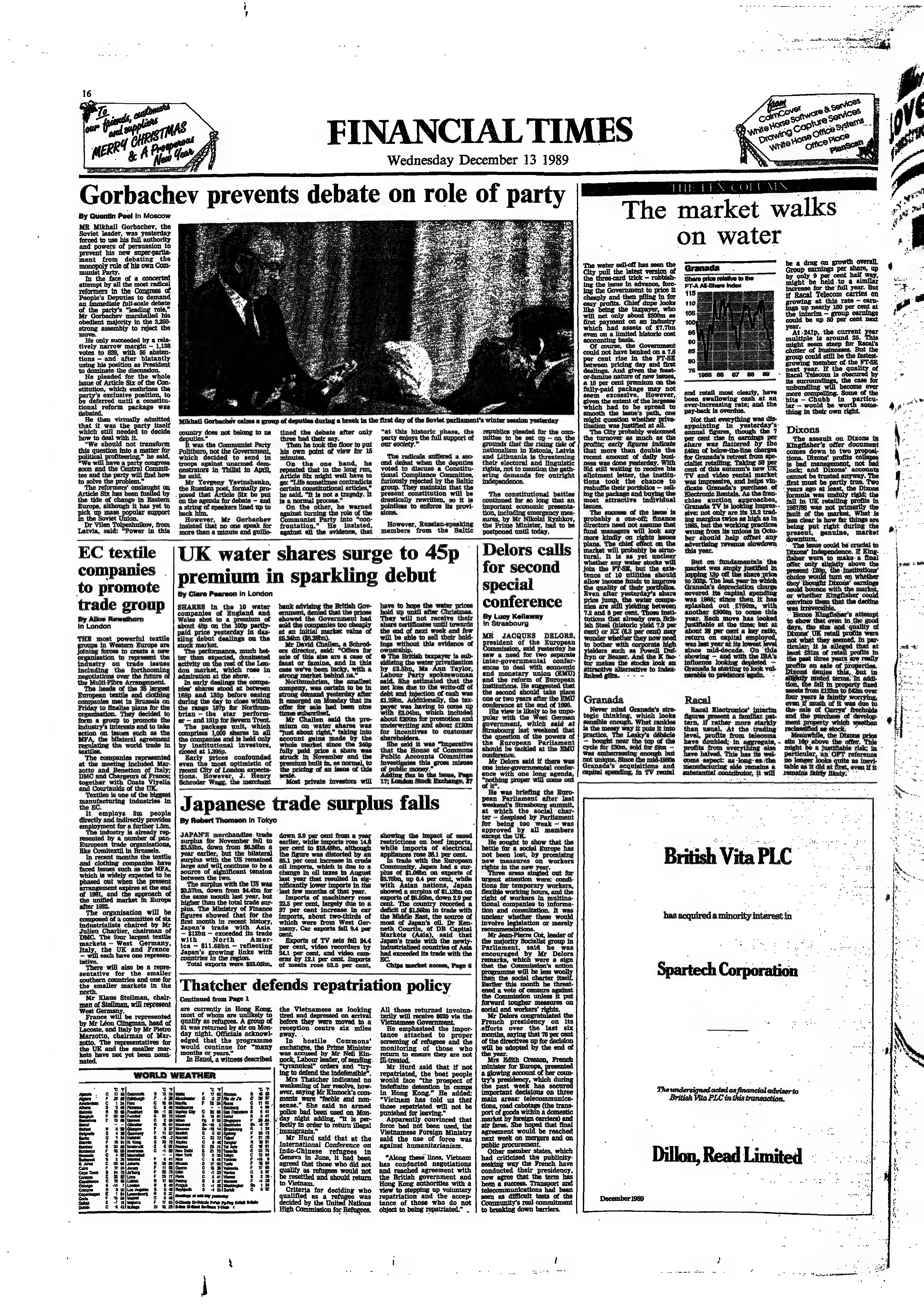
Four years before privatisation, the state was already making water customers pay more in order to improve the public accounts. This was not the failure of some remote and unaccountable bureaucracy. It was ministerial policy. Baker took his proposal to the Chief Secretary in November 1985 and records the Treasury’s delight, including the amazement of one official that anything so congenial could have come out of the Department of the Environment. He announced the plan to the Commons on 2 February 1986. The Daily Telegraph found the arguments compelling. Some of his own side muttered about the family silver.
The difficulty for Baker is that he understood what he was selling. The water authorities were large natural monopolies. A household could not choose another supplier. Competition, he admitted, would exist only in the industry’s ability to attract money from the world’s capital markets. Water would therefore require strict regulation on quality and public health grounds.
That was the market mechanism in its entirety. The monopoly remained. A regulator would take the place of competition, while the owners competed for access to global finance. The one competitive arena Baker could identify was also the place from which the predators later arrived. World capital markets competed for Thames Water exactly as promised. Macquarie won.
I wanted to write that Baker was simply wrong. The record says something stranger. Privatisation did protect water’s capital spending from the Treasury, precisely as he promised, and his 1993 boast that £5,000 a minute was being spent on quality for the rest of the century was, for a while, true. What the model could not do was protect the revenue from the owners. Macquarie and a string of offshore pension funds held Thames for a decade from 2006 and took roughly £2.7bn out in dividends, through a corporate structure so layered that the money’s route out of the country was itself a marvel of engineering, and every pound of it rested finally on the bills of households who had no other tap to turn to. The borrowing Baker imagined replacing Victorian sewers funded distributions instead. His £5,000 a minute reads now as the prospectus for the debt-loading that followed. The £21bn pile is not an unfortunate legacy of an otherwise sound model. It is the residue of extraction, and the extraction was the model.
Chris Weston, Thames Water’s chief executive, warned this month that a nationalised Thames would sit on the public purse, “competing for funding with the NHS, with the military, with education.” In 1993 the Treasury was the menace from which privatisation had rescued water. In 2026 the Treasury is the reason water must remain with the funds. Same institution, same argument, run in reverse by the people the first version enriched. Baker at least believed the capital programmes mattered. His successors invoke the Treasury purely as a shield.
Baker’s fiscal history holds up, which is the uncomfortable part. Municipal and nationalised water genuinely was starved, and any defence of public ownership that skips past this hands Baker his counterfactual. The question is why it was starved, and the answer sits in the accounting rather than in the ownership. Treasury rules scored the industry’s borrowing against the public books, so investment in pipes lost every annual contest with schools and hospitals, a contest no water authority could win and no Chancellor wanted to referee. That starvation was a political choice about how to count, made by governments of every complexion, and Baker’s remedy was to move the industry off the books rather than change the books. Other countries changed the books. The Dutch fund their public water boards through a dedicated state water bank whose borrowing does not queue behind the health service, which is why the FT’s Lex column, conceding in May that nationalisation might now be the least bad option for Thames, reached for the Netherlands as a template while noting that fully privatised water leaves England keeping company mainly with Pinochet’s Chile. There is an older precedent still, and Baker himself supplies it in a stray paragraph on the history of the rates: water and sewerage were once unambiguously municipal services financed through property taxation, and before the First World War the rate revenue funding them exceeded the annual yield of income tax. The starvation Baker describes belongs to the postwar Treasury settlement, not to public ownership as such. He treated a bookkeeping convention as a law of nature and sold an industry to escape it.
His own party knew the price at the time. By 1989 Baker was Party Chairman and lists water privatisation, in his survey of the wreckage, among the three policies bleeding the Government, alongside the health reforms and the poll tax. Thatcher swiped publicly that spring at how the sale had been handled, then insisted she had meant the press coverage, and nobody believed her. Baker defended the policy from the conference platform that autumn, telling the party it had not been re-elected twice in order to manage national decline more politely than Labour would. The flotation landed in December 1989, weeks after the first challenge to Thatcher’s leadership. In the middle of all this, an aside he records without apparent irony: Thames Water vacated its building next door to Conservative Central Office that August, and the Party bought the freehold for redevelopment at the top of the market. The privatised utility and the party that privatised it, swapping property while the bill for the whole experiment began its long journey towards the customers. Labour, for what it is worth, committed immediately to renationalisation and held the position until after the 1992 defeat. Burnham is not proposing anything New Labour did not first abandon.
Ownership is half the question. The other half is who the water is for, and here the state has been answering without admitting that a question exists. Water UK, the trade body for the water companies, told MPs this month that the government’s forecasts for AI-driven growth are “fatally flawed” because they exclude datacentres from national water planning altogether. Across the AI growth zone policy, the AI for science strategy and the opportunities action plan, the briefing found not a single mention of water. Policy proceeds, Water UK observed, on the assumption that the country will always have water enough for whatever the economy proposes to do with it. The numbers say otherwise. Datacentres in England already take 6.6 million litres of treated drinking water every day, and the government’s ambition to triple capacity by 2030 would push that towards 20 million. A House of Lords report in May put England’s public supply shortfall at five billion litres a day by 2055. The current deficit already runs 220 million litres a day beyond what the forecasts assumed, a gap met by drawing harder on rivers and aquifers and by asking households to go without in drought. Three-quarters of the datacentre estate sits in the south and east, where millions of people spent this summer under hosepipe bans. Around Slough, in Affinity Water’s region, another 125 datacentres are proposed or under construction, some requesting three million litres a day each, the peak demand of three and a half thousand homes, and Affinity told MPs that a planning framework built around households and per-capita consumption has no way of reckoning with commercial users whose thirst matches a market town’s. A new reservoir takes fifteen years to plan and build. The datacentres are being approved now.
The government has meanwhile designated datacentres critical national infrastructure, a status reserved for assets whose loss would damage essential services or the functioning of the state. It has not published a drought hierarchy, though Water UK has asked for one. Refusing to publish the ordering is itself the ordering. Infrastructure that must not fail on one side, households that can be asked to let their gardens die on the other, and campaigners already predicting that server halls running chatbots will draw protected supply while the people around them queue. Water UK, remember, speaks for the privatised companies rather than for any citizens’ campaign, so the briefing records one fraction of capital objecting that the state has promised another fraction a resource that does not exist. The state’s response to this dispute inside the bloc has been silence and a delayed policy statement.
The argument has a landscape. At Great Torrington in Devon, Xlinks, the company previously known for a failed plan to cable solar power from Morocco, wants 850 acres for what would be the largest datacentre in Britain, buildings forty metres high, £13.8bn of investment, a promise to cool the servers with rainwater rather than the River Torridge. Barbara Fryer grazes cattle near the site. “There isn’t the water for it,” she told the Telegraph, describing brown grass, a falling water table, less food coming off good agricultural land. More than two thousand people have signed the petition against the scheme. The opposition is not unanimous. One dairy farmer reasons that if the sheds must go somewhere, better a place where rain still falls, which is a fair point that concedes everything, because it accepts that the siting of computation is now governed by where in England the water holds out.
None of this makes public ownership a spell. Scottish Water charges its customers about £100 less a year, which is a fact rather than a proof, and the Lex column case for nationalisation is managerial through and through: sounder balance sheets, cheaper borrowing, investment “freed from the temptation to pay big dividends.” All true, and insufficient, because it treats the past thirty-seven years as an administrative error awaiting better administrators. The stronger claim is older and plainer, as old as the rates that once paid for the pipes. Water is a precondition of life and of the food that sustains it, and a precondition cannot circulate as a commodity without producing exactly the absurdities now on display: lawyers against mandates, chatbots against cattle.
There is a recent precedent for paying the owners of broken things what broken things are worth. On 16 July the government took British Steel fully into public ownership, fifteen months after seizing operational control from Jingye, whose furnaces were losing £700,000 a day and heading for closure. Jingye says it was offered virtually nothing, demands full compensation, and threatens arbitration under the UK-China investment treaty, with an independent assessor left to decide in the autumn whether anything is payable at all. The valuation logic is older than Scunthorpe. Northern Rock’s shareholders received nothing in 2008 because the courts assessed the bank as if no state support existed, and without state support there was no bank. Railtrack’s shareholders sued over the same treatment in 2001 and lost. Thames sits squarely in that line by its own account, since the annual report concedes the company cannot fund itself past December. Water needs no emergency act, either, because the mechanism has waited in statute since 1991: special administration keeps the taps running while a court-appointed administrator settles what the business is actually worth, which for a company that dies without the state is very much less than £21bn. Burnham does not need to seize anything. He needs to refuse the rescue and let the funding wall arrive, at which point insolvency, capital’s own rulebook, writes down the funds’ claims. The creditors’ litigation makes sense only as an attempt to close that road before December opens it. Apollo and Elliott, unlike Jingye, have no investment treaty to run to; they would argue in English courts, under precedents that have already blessed paying nothing for worthless things. None of it comes cheap, because the state would front billions in working capital through an administration, and Weston’s line about the NHS would run daily while it did. The option exists all the same.
What remains is a question of nerve rather than of law. A state rescue of Thames is priced at around £4bn, the creditors will argue in court for considerably more, and the Macquarie era took £2.7bn out. If the funds are made whole, the public buys back the family silver at a valuation set by the people who stripped it. Burnham has said public ownership is what should be done and has not yet said what public control means. The creditors have already said what they think it means: something to be litigated. Baker believed he had settled all this on 2 February 1986. He had not. Nearly forty years later, the fate of Thames Water may be decided in court, while another dry summer shows what privatisation has left behind.
Thanks for reading Anti-Capitalist Musings. It is a small operation, and I hope it offers something worth your time. There will be no premium subscriber content here: everything published will remain free to read. If you value these pieces and want to support the writing, buying me a coffee helps fund media subscriptions and the books that keep the analysis grounded. Every contribution, however modest, is genuinely appreciated.
Excellent explanation of how we got where we are and how we all got ripped off. We need to make sure it doesn’t keep happening.
You are right to flag up data centres too - these are not the cure for unemployment they are claimed to be once constructed, and have a massive impact on water and electricity consumption.
Don't hold your breath. But certainly wait and see.