
The Grin Without a Cat
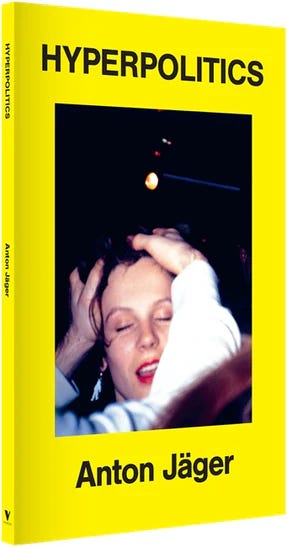
Anton Jäger’s Hyperpolitics and the Problem of Institutional Wreckage

"Postpolitics is over. The eschatological rumor that politics is dead, as Ernaux had it, has been disproven. For now, however, it is as if our patient has awoken from a coma to a state of frenzied activity, without ever coming to terms with the symptoms."
Anton Jäger, Hyperpolitics, p. 93
In September 1957, the four-masted barque Pamir sent its final distress call from the Atlantic. The training ship had sailed from Buenos Aires carrying 4,000 tons of barley bound for Hamburg. A hurricane caught the vessel southwest of the Azores. Investigators later discovered that time pressure had led to a fatal error: instead of stowing the grain in sacks as usual, the cargo had been poured loose into the hull. When the storm hit, the barley shifted uncontrollably from side to side. The ship lost equilibrium, capsized, and sank. Of eighty-six crew members, only six survived.
Anton Jäger uses the Pamir as an emblem for contemporary politics. In earlier times, individuals were embedded in dense social networks and intermediate associations. Today’s societies are composed of increasingly atomised individuals. As long as history moves smoothly, this need not create problems. But when societies enter rough waters, atomisation amplifies volatility and collective incapacity. Like loose grain in a hull, isolated citizens cannot provide the ballast that once stabilised political systems under pressure.
Hyperpolitics arrives at a moment when the left badly needs such diagnostic clarity. The book offers a precise account of our political impasse: extreme politicisation without political consequences. We have mass mobilisation without mass organisation, passionate engagement without institutional power, Twitter storms that leave the material world untouched. Jäger traces this condition to the decomposition of the dense associational networks that once translated individual grievance into collective force. Without trade unions, mass parties, churches, and workplace organisations, political energy dissipates into digital spectacle. The analysis is sharp, the evidence compelling. What remains uncertain is whether Jäger grasps the full extent of the wreckage or whether his proposed remedies address the depth of the crisis.
The Periodisation
Jäger’s central claim divides recent political history into four distinct periods, mapped along two axes: levels of politicisation and degrees of institutionalisation. This framework provides analytical clarity for understanding our current impasse.
The era of mass politics, running from the late nineteenth century through the 1980s, occupied the quadrant of high politicisation and high institutionalisation. Workers belonged to unions that negotiated wages, organised strikes, and maintained social clubs. Political parties commanded millions of dues-paying members who attended branch meetings and canvassed neighbourhoods. Churches provided moral frameworks and communal belonging. This network gave working-class politics what Jäger calls “fat”: the social weight required to translate demands into policy changes.
The post-political period, from the 1990s through 2008, saw both politicisation and institutionalisation collapse. Technocratic governance replaced democratic contestation. The great ideological conflicts appeared settled. Parties converged on market-based solutions. Citizens retreated into private life, consumerism, and what Michel Houellebecq captured as terminal apathy. Turnout declined, membership organisations collapsed, public space emptied out. This was Wolfgang Tillmans photographing ravers in 1989, dancing away industry and history itself.
The symbolic transformations were stark. In 1992, Guy Debord anticipated a planet “officially unified” as “a single bloc in the consensual organisation of the global market.” Two years later, the Communist Party of Italy’s erstwhile leader Achille Occhetto travelled to Wall Street, declaring its banks “the temple of civilisation”; NATO headquarters in Brussels, he ventured, was “the centre of world peace.” When Tillmans designed posters in 2016 for Britain to remain in the European Union, the slogans captured what had been lost: “No man is an island. No country by itself.” “What is lost is lost forever.” “It’s a question of where you feel you belong. We are the European family.” Set against Tillmans’s heavenly backdrops of sky seen from airplane windows, the posters offered references from the 1990s: figures of empathy, unity, love. This was “art after liberalism,” as one critic put it, trying to resurrect a utopia that was already fracturing.
Annie Ernaux, a French writer, documented the atmosphere with focused ambiguity. “The rumour was going around that politics was dead. The advent of a ‘new world order’ was declared. The end of History was nigh. The word ‘struggle’ was discredited as a throwback to Marxism, become an object of ridicule.” Voting became “a private, emotional affair, governed by last-minute impulse.” “Everything is permitted but nothing is possible,” declared philosopher Michel Clouscard. Cornelius Castoriadis saw “a society adrift” amidst “a rising tide of insignificance.”
This was deliverance from twentieth-century ideological orthodoxies. Baudrillard dismissed the era’s soft ideologies: “human rights, dissidence, antiracism, SOS-this, SOS-that” were “post coitum historicum ideologies, ‘after-the-orgy’ ideologies for an easy-going generation which has known neither hard ideologies nor radical philosophies.” They were the “spoilt children of the crisis, whereas the preceding one was that of the accursed children of history.”
The financial crisis shattered this quiescence. Between 2008 and 2016, an antipolitical decade saw politicisation return without institutional reconstruction. Occupy Wall Street, the Indignados, Syriza, Podemos, the Five Star Movement, Corbynism, Sanders: all attempted to challenge the postpolitical consensus through movements lacking the organisational density of historical mass parties. Stéphane Hessel’s 30 page pamphlet Time for Outrage sold a million copies. Demonstrations surged globally. Yet these movements proved evanescent, unable to translate popular energy into sustained institutional power.
As Alex Hochuli, George Hoare, and Philip Cunliffe describe the mechanism: “The strategy of depoliticisation known as post-politics breeds an angry reaction: the institutions of formal politics come to be rejected by citizens. At the End of the End of History, antipolitics becomes the predominant force.” If we look at the Tea Party and Occupy Wall Street as paradigmatic examples of right-and left-wing antipolitics respectively, it remains striking that historically proletarian strata did not occupy the front ranks of protest. What stands out are different middle-class factions: the traditional conservative petty bourgeoisie and frustrated, downwardly mobile millennials.
Since 2016, we have entered hyperpolitics proper: a condition where politicisation becomes universal and permanent while institutional capacity remains absent. The gap between politics (public discourse) and policy (actual state governance) widens into an unbridgeable chasm. Digital platforms generate continuous outrage. Protests draw millions. Governments carry on largely unchanged. What distinguishes hyperpolitics from antipolitics is that the entire public sphere now operates in crisis mode. Brexit and Trump’s election shocked formerly passive liberals into reactive politicisation. Black Lives Matter and the Capitol riot represent morally opposed movements that share organisational similarity: bodies without organs, concentrated and muscular yet lacking internal metabolism.
As one American journalist confessed on the eve of the 2020 election: “I’ve always been interested in politics. For much of my life, this was a niche interest. The election of Donald Trump has made politics all consuming. Everything has become political; from what sports you watch, what products you buy, and even how you protect your own health.” Third-tier staffers became celebrities. People who once shared cat videos now shared stridently political memes.
Yet this frenzy masks impotence. In contrast to the “high” politics of 1918 to 1989, hyperpolitics is an abidingly “low” form: low-commitment, low-cost, and low-value. It is, above all, eminently market-friendly in form and content. Markets offer exit options; by nature, they focus on the short term. Politicians navigate by election cycle and polling averages. Citizens turn out to demonstrate for a day. Influencers petition or protest with a tweet. Postpolitics may be over, but its successor would be unrecognisable to a time traveller from the early twentieth century.
The Asymmetry
A crucial dimension of Jäger’s analysis concerns why right-wing antipolitics succeeded while left-wing variants collapsed. The explanation centres on different organisational requirements. Right-wing movements can function through neo-Bonapartist acclamation: Trump, Salvini, and Bolsonaro bypass established institutions to rile up atomised supporters via transgressive social media without requiring sustained participation. Whether their voters live in isolated fragments, like Marx’s proverbial potato sacks, matters little. The model suits contemporary conditions perfectly.
The left faces higher barriers. As Engels observed, workers “cannot do without a strong organisation, well-defined by rules.” Left parties require what Gramsci called “a collective will, which has already been recognised and to some extent asserted itself in action.” In the twenty-first century, this task grows more difficult because the left cannot rely solely on a diminished working class but must unify divergent fractions: politicised millennials, segments of the new petty bourgeoisie, ideally even conservative-leaning milieus.
Laclau and Mouffe’s theory of “chains of equivalence” offered theoretical justification for this strategy. Podemos, Syriza, and Corbynism all attempted to construct heterogeneous alliances that transcended class boundaries. Iglesias’s strategist Íñigo Errejón insisted they operated “beyond left and right,” while Mélenchon campaigned as “angry, but not fascist.” Yet such cross-class coalitions proved unstable. Corbyn’s ambiguous Brexit stance reflected the impossible task of reconciling Euroskeptic working-class voters in England’s Red Wall with pro-European millennials in London. The institutional challenge of organising in an era of deinstitutionalisation was overlaid by an older social-democratic dilemma about which constituencies to prioritise.
The right retained structural advantages. While Conservative Party membership collapsed from 2.8 million in 1953 to 170,000 in 2022, and Thatcher’s market reforms decimated the Tories’ provincial base, the institutional infrastructure supporting right-wing politics proved more resilient than its left equivalent. Private schools, the Anglican Church, wealthy housing districts, and homeownership provided a social substrate that the left, dependent on unions and workplace organisation, lacked after deindustrialisation. As César Rendueles notes, “the upper classes managed to shield themselves from postmodern individualisation by preserving their social capital through elite educational establishments or affinity networks bound up with lifestyle.”
The physical transformation of working-class life was equally deliberate. In the United States, middle-class families’ flight to the suburbs beginning in the 1960s left many in neighbourhoods exclusively designed for motorists, without footpaths. Corner stores were bulldozed to make way for shopping malls. Commuter rail infrastructure lost out to highways. Collective life had to be thinned out to clear new inroads for the market. Consumption was democratised, but the spaces where workers had once gathered were systematically eliminated. People spent more time in their cars, a mobile privatisation of public space.
Conservatism grows organically from capitalist society, soldered by the default forms of association that capital generates. Engels explained the asymmetry: capitalists need no formal organisation because “their small number, as compared with that of the workman, the fact of their forming a separate class, their constant social and commercial intercourse stand them in lieu of that.” Workers, lacking such natural cohesion, require deliberate institution-building. The crisis of civil society diagnosed by Robert Putnam poses a greater problem for the left, since the bar for success is set higher.
The digital age intensified this asymmetry. As journalist Matthew Yglesias observed, “sitting at home alone has become a lot less boring.” Netflix, drugs, and delivery services turned the twenty-first-century home into a self-enclosed repository of creature comforts. The ability to “stream alone” drove up the opportunity costs of other activities. Why attend a union meeting when entertainment arrives on demand? Why join a party branch when political engagement can be performed through tweets? The market provided individualised substitutes for every collective good, making isolation comfortable rather than oppressive.
Jäger documents this shift through Putnam’s data on declining social capital in America: fewer friendships, empty bowling leagues, collapsing voluntary associations. He analyses the populist left’s failures, from Syriza to Corbyn to Sanders, showing how movements lacking organisational “fat” proved unable to withstand institutional pressure. He tracks the rise of professional NGOs that replaced membership organisations, creating what he calls “heads without bodies”: elite advocacy groups recruiting donors rather than building power bases. The 2008 crisis saw states intervene to save markets, but because the public was atomised into consumers, no organised body could demand a democratic alternative.
Baudrillard’s Shadow
The book opens and closes with Jean Baudrillard’s observations about American power in the late 1980s. Baudrillard noted a paradox: “America no longer has the same hegemony,” yet “it is, in a sense, uncontested and incontestable.” American power worked “by inertia,” entering a phase of hysteresis whereby effects persist even when causes have disappeared. This was “a potential stabilisation by inertia, of an assumption of power in a vacuum,” like “the loss of immune defences in an overprotected organism.”
The metaphor structures Jäger’s entire analysis. Hyperpolitics represents hysteresis in political form: intense activity persisting without the conditions that originally generated meaningful politics. The institutional infrastructure that made democratic participation consequential has been destroyed, yet political passion continues and even intensifies. We have the grin without the cat, to borrow from Baudrillard’s preferred Lewis Carroll image.
Baudrillard’s later work on “the illusion of the end” proves equally relevant. Rather than history ending, as Fukuyama proclaimed, history appears to have entered a “strike of events”: scattered fragments and phases we thought finished reactivating themselves. “Today,” Baudrillard wrote, “we are caught as a species in a similar impasse, trapped between our fossils and our clones.” Hyperpolitics embodies this temporal confusion. We experience neither posthistorical quietude nor genuine historical rupture, but rather a permanent oscillation between manic activity and depressive resignation, both reflecting inability to repair what Freud called the loss of the libidinal object.
Peter Sloterdijk provides additional conceptual scaffolding. His 1993 book Im selben Boot (In the Same Boat) coined the term “hyperpolitics” to describe contemporary political conditions. Sloterdijk traced human history through maritime metaphors. The paleo-political period resembled an argosy of rafts on which small groups drifted through time without forming definite projects. The Axial Age brought state galleys and imperial frigates, with pharaohs and caesars uniting masses to construct irrigation projects and fight crusades. Industrialisation and global interconnection produced the hypersphere: rulers and ruled blurred together, ordinary people preoccupied themselves with questions once reserved for foreign ministers, social cohesion became difficult to sustain.
Sloterdijk’s preferred image for this final stage was super-ferries “so vast as to be almost unsteerable, plowing through a sea of drowning people, with waves battering the hull and anxious conferences unfolding onboard.” The journey into contemporary hyperpolitics felt “like a high-speed train ride into an empire of confusion.” Politics resembled “a chronic near-miss mass-collision on a foggy motorway.”
Western democrats, Sloterdijk observed, no longer styled themselves as such from any pretence of contributing to the public good. They simply recognised democracy as “the type of society that allows them not to think about the state and the art of belonging together.” The individualism spreading across the West in the 1980s and 1990s constituted “a new wave of insulation” beyond familiar European individuation. People were sealing themselves off not just from institutions or parties but from society itself, drifting into “a second-order solitude among their peers.” “The single-occupancy apartment,” Sloterdijk concluded, “is the vanishing point of civilisation, and living alone the crowning achievement of a millennia-long process of anthropological refinement.”
Jäger’s Pamir metaphor updates Sloterdijk’s super-ferry for our more precarious age. The super-ferry at least remained afloat, however unsteerable. The Pamir capsized because its cargo was not properly secured. Contemporary societies face similar catastrophe: when storms hit, atomised citizens shift chaotically rather than providing collective ballast.
The Ambition
Hyperpolitics succeeds where much contemporary left writing fails. Jäger refuses the consolations of either pessimistic fatalism or optimistic voluntarism. He neither declares the working class dead nor pretends that online organising can substitute for institutional power. The book recognises that our political predicament cannot be solved through better messaging, more radical demands, or tactical innovation. The problem is material: we lack the organisational infrastructure that made collective action possible.
This insistence on materialist analysis distinguishes Jäger from theorists who treat politics as primarily discursive. Where post-Marxist populism imagines that the right rhetorical “chain of equivalence” can conjure a revolutionary subject, Jäger demonstrates that rhetoric without organisation produces only temporary excitement. Podemos, the Five Star Movement, Corbynism: all collapsed when confronted with state power because they lacked the dense networks that could sustain them through institutional conflict.
The cultural analysis reinforces the historical argument. Jäger uses Michel Houellebecq as a barometer of changing political atmospheres. Houellebecq’s 1990s novels captured postpolitical nihilism perfectly: Whatever (1994) chronicled a generation that knew neither politics nor history and simply chased instant gratification. The Elementary Particles (1998) documented hedonistic vacancy. By Platform (2001), paranoia was creeping in as Islamic terrorists attacked the beach resort Westerners had built for themselves. Submission (2015) imagined Islamists founding a caliphate on the Seine, showing that antipolitics could not fulfil the expectations it generated.
Then Houellebecq’s grip faltered. Serotonin (2019) presaged the Yellow Vest protests with uncanny accuracy, depicting armed farmers assaulting police on motorways. But Annihilation (2022) read as if written compulsively and in haste, uncharacteristically mellow. The central subject of Houellebecq’s most original work had become unreliable as a target. The postpolitical subject he had anatomised so ruthlessly was mutating into something else. As Christopher Caldwell noted, the postpolitical age required dismantling hierarchies, institutions, and cultures, which generated problems for novelists since “the same hierarchies, institutions, and culture are what novels have always been about.” Houellebecq “faced this predicament with artistic integrity, refusing to fantasise that individuals in our time can somehow be re-inserted into such ‘novelistic’ webs of meaning.”
But hyperpolitics presented a different challenge. The characters in Annihilation no longer appeared as resigned victims of neoliberal restructuring. Rather, they were “men and women outside of history, facing a godless universe as Christians without a church.” The sister’s Catholicism was purely performative, detached from any concrete denominational infrastructure. Houellebecq referenced nearly every contemporary political orientation but they figured merely as unwitting agents of a “gigantic collapse,” natural disaster personified by Paul’s father’s comatose state. The great portraitist of the postpolitical subject had lost his model. In early 2022, Houellebecq announced that Annihilation would be his final novel. The culmination of postpolitics thus coincided with the completion of an oeuvre.
Hyperpolitics would be unthinkable without particular social preconditions. It is rooted in a society where exit options abound and citizens move easily from one institution to another. Just as employment has become precarious, abandoning a family, relationship, party, or circle of friends is far less demanding than in Weber’s time. The life-worlds of the online provide the primary environment for this deinstitutionalised, impermanent engagement. Atomisation and acceleration go hand in hand: people are lonelier in the new century, but also more agitated; more atomised, but also more connected; angrier, yet more disoriented.
The American Case
Jäger’s extended preface on American politics demonstrates how hyperpolitics operates at the imperial centre. The 2024 election crystallised the condition. Electoral participation reached its second-highest level in over a century despite both parties functioning as what Engels described in 1891: “two great gangs of political speculators, who alternately take possession of the state power and exploit it by the most corrupt means and for the most corrupt ends.”
The social anatomy of the parties reflects shifting tectonics of American political economy. Trump assembled a cross-class, carbon-intensive coalition: rural petty bourgeois, exurban middle management, real estate capitalists, crypto merchants, Silicon Valley’s right wing, steel producers who survived the 1980s laissez-faire onslaught. The coalition benefits from the antimajoritarian features of the Constitution and relies on voter suppression for its mandate.
The Democrats redefined the notion of “inter-class coalition.” The party houses urban professionals, left-liberal activists, civil rights veterans, intelligence operatives, and every faction of American capital from Palo Alto progressives to Wall Street haute finance. As one observer noted, it functions as “the party of labour and of capital; the party of debtors and of bankers; the party that mocks the Ivy League but is largely run by Ivy Leaguers; the party of anti-monopolists and of Silicon Valley; the party for immigrants and for border security; the party that opposes fascism but abets a genocide.” That even-handedness requires correction: bankers and warmongers predominate in ruling circles, the indebted and marginalised among the rank and file. The nearest comparison would be an inverted Peronist developmental bloc, with the industrial proletariat left out and finance capital firmly in the saddle.
Political emotions have become more heated and tenacious. Two assassination attempts on Trump already outpaced the last four decades. Compared to how quickly outrage over Bush v. Gore subsided in 2000, supposed democratic backsliding now generates sustained indignation. Polarised, paranoid, zero-sum, American political life now outstrips much of Europe in terms of voting tallies and popular involvement, as well as cultural partisanship. Consent to the American ruling order can no longer be taken for granted.
Yet policy remains unchanged. Both parties commit to preserving American hyperpower abroad. Varieties of marketisation characterise political offerings: transfer states stimulating ecological investment through subsidies and profit guarantees for Democrats, tariff walls and tax cuts for Republicans.
The fascism analogy, prevalent among coastal intelligentsia since 2016, lacks bite on many fronts. Most of all, it suppresses one key element of any far-right threat throughout the twentieth century: the presence of a left on the verge of revolutionary breakthrough. Even in conventional analyses, fascism had to be understood on a dual timeline: an inability of bourgeois classes to stabilise their rule after the Great War, and an increasingly assertive proletariat vying for state power. Caught in this limbo, ruling elites invited the parties of frustrated veterans to step in and smash the anticapitalist threat. Fascism expressed both the resolution and repression of the revolutionary intermezzo. By these standards, present-day right-wing populism lacks essential criteria: there is no prerevolutionary working class poised for power, and no Western polity has experienced total war with its brutalising initiation into violence.
The term “party” flatters these loose coteries of elected officials, donors, publicists, and would-be candidates. They have no formal membership models and little civil society infrastructure except NGO personnel. They function as para-state vessels that have changed little since Engels described them. After a decade of political turmoil, civic membership and associational density remain at historic nadirs. For social movements operating in debt-driven service economies, online solidarities cannot replace those of local communities and workplaces.
The Squad exemplifies the impasse. After a decade of experimentation with semi-independent party activity, it remains an anxious battalion for a better Democratic Party rather than an autonomous force. Heightened political emotion has been captured by party cartels. The upshot is not dysfunctional for the ruling order. It presages more of the same: extraparliamentary challenges, legal contestation, high political emotion, and the promulgation of bipartisan agenda that passes gridlocked Congress. Hysteresis has a long way yet to run.
The Historical Chasm
The historical comparison proves instructive. Jäger quotes Eric Hobsbawm’s account of a 1933 Communist demonstration in Berlin, where the teenage historian marched with comrades from a paramilitary organisation, singing songs selected and printed by party representatives. The march produced what Hobsbawm called “mass ecstasy,” a collective experience that bound individual participants into a larger political project. Contemporary protests generate similar emotional intensity but lack the organisational substrate. People attend Black Lives Matter demonstrations, experience genuine solidarity, then return to isolated apartments with no institutional connection to sustain political engagement.
The contrast extends beyond demonstrations. In early twentieth-century working-class communities, politics pervaded daily life. Gáspár Miklós Tamás describes a 1906 Hungarian workers’ housing estate in Transylvania: each flat contained portraits of Marx and Lassalle, workers practised teetotalism and atheism in defiance of surrounding society, they rejected non-socialist charities and held parties only in daylight to avoid immorality. “Admirable as this is,” Tamás writes, “it must have been, for all intents and purposes, a sect.”
Their membership card meant more than material advantages. As a symbol, it stood for total, immersive belonging to a community and way of life. In a society hostile to their interests, emotions, and habits, the Party supplied cohesion and a stable sense of self. By promoting a worldview, political parties helped members make sense of the world. Through ideological training, parties imposed a shared outlook that allowed workers to grasp abstract social processes as amenable to transformation.
Ideological disorientation is a hallmark of the hyperpolitical age. Debate erupts over one issue today, another tomorrow. But individuals no longer possess a heuristic capable of unifying and imposing coherence on their various viewpoints. This is not simply a question of having correct opinions but of possessing frameworks that connect particular positions to broader analysis. The catch-all party and NGO model abandoned this function entirely, treating politics as a series of discrete issues to be managed through technical expertise rather than a totalising conflict requiring strategic coherence.
Tamás’s own family history illustrates the depth of political commitment. His parents were Communists; his Jewish mother escaped deportation to Auschwitz only because she was already imprisoned as a Bolshevik. Disillusioned by postwar Stalinisation, they nonetheless remained staunch party loyalists. As a teenager, Tamás asked his father why he still called himself a Communist despite complete disenchantment with the system. His father showed him a small bakelite cube with six photographs glued on its sides: portraits of his closest friends from youth, tortured to death by Hungarian and Romanian secret services or the Gestapo in 1944. “Because I cannot explain it to them,” he said.
This raises the anthropological question that haunts Jäger’s analysis. Was the mass-political dynamism of social democracy’s idealised golden age not in fact a contingent product of specific social conditions? Before modernity, societies were perhaps so totally institutionalised through feudal structures, religion, tradition, and guild regulations that no space existed for political agency in the modern sense. Then came industrialisation, urbanisation, democratisation, liberalisation, and educational expansion, contributing to the trends Putnam surveyed, down to our individualised and deinstitutionalised hyperpolitical present.
Harold Laski wrote in 1916 that “man is so associative an animal that his nature is largely determined by the relationships thus formed.” In this optic, working-class organisations could reach for a secure anthropological basis. Lenin’s understanding of revolutionary class consciousness assumed a nearly irresistible drive toward association on the part of workers, who then had to be spurred beyond narrow corporatism by a revolutionary party. Today, as Gopal Balakrishnan observes, “not even a spontaneous trade union consciousness can be assumed.”
The problem runs deeper than organisational weakness. Sociologist Ingolfur Bluhdorn notes that Westerners emancipated themselves twice: first from traditional authorities, then from the kind of political commitment required to accomplish that emancipation. The corrective to our hyperpolitical impasse (drawing atomised individuals back into parties and unions) may seem nostalgic, authoritarian, or simply unrealistic. Who could command them to reverse course? Did people in the past truly join unions, parties, and religious associations voluntarily, in the same way that a Houellebecq protagonist picks an exotic vacation package from a catalogue? Or did they do so simply because it was customary, in their milieu, their family, their workplace, and because their fathers and grandmothers had done so before them? A matter of free choice or institutional inertia?
Jäger recognises that recreating such conditions through voluntaristic effort verges on impossible. The Prussian militarist revival will not arrive because German disco-goers lack martial vigour. Mass parties cannot be reconstructed through genomic engineering, extracting DNA from the Siberian permafrost of industrial-era politics. The question becomes: if institutional “fat” emerged from specific historical conditions now extinct, can it be rebuilt at all?
As sociologist Ingolfur Bluhdorn notes, Westerners emancipated themselves twice: first from traditional authorities, then from the kind of political commitment required to accomplish that emancipation. Who could command them to reverse course? Hyperpolitics is the product of a hard but hollow environment, an attempt to break the iron grip of neoliberalism without the requisite tools. The neoliberal state began as an interventionist experiment to shield the market from mass democracy. That was its avowedly hard side. To achieve this, however, it had to sever the party ties that bound it to popular constituencies. In its mass-political phase, party democracy acted as a brake on capital accumulation. The response was to hollow said parties out and transform the state from an active agent into an impartial arbiter.
The Evasions
Here the analysis encounters difficulties. Jäger identifies the crisis with precision but treats its origins with surprising vagueness. Institutional decomposition did not happen accidentally. It resulted from sustained political assault, coordinated by capital and executed through state power. Yet Hyperpolitics approaches this history obliquely, through scattered references rather than systematic examination.
The inflation analysis reveals this evasion. After an era of postpolitical stability blessed with steady prices and wage restraint, the pandemic triggered sector-specific inflation that escalated after the Ukraine war. Warnings of wage-price spirals were revived. Central banks responded with sharp interest rate hikes. Yet something crucial had changed. Most twentieth-century inflation episodes resulted at least in part from collective wage demands. Inflation was not merely a technical datum but “an index of history”: the moment when labour became a political actor with a claim to its share of the collectively generated surplus. Neoliberalism set out to reverse this metamorphosis.
With the fissiparation of the workers’ movement, such pressures dwindled. The Great Resignation galvanised by American and EU stimulus checks yielded a politics of radical exit, not voice. Strike activity has seldom been lower. “The working class as a cohesive social force no longer exists,” the Financial Times reported in 2022. “Businesses can safely protect their margins and the burden of inflation will fall on labour as real wages fall.” If class struggle is history’s motor, and if strong trade unions generated the cost-push cycles of past decades, inflation’s resurgence should signal the engine running again. But contemporary macrodata scarcely bear this out. Contemporary inflation is driven by the vagaries of a leaderless and anarchic world economy, where modest wage gains are easily offset by ballooning costs and energy prices.
Capital scoured the social landscape. The institutions that once provided workers with bargaining power and political identity were systematically eliminated. What remains: digital platforms designed to monetise engagement, NGOs that professionalise advocacy, protest movements that generate catharsis without strategic capacity. Jäger documents these results but obscures the agency behind them.
Consider Jäger’s account of Thatcherism. He notes that the Iron Lady “decimated” the Conservative Party’s provincial base through privatisation and market reforms, damaging both Labour and Tory institutional infrastructure. He observes that deindustrialisation scattered working-class communities. He mentions Putnam’s data showing civic decline beginning in the 1970s. These fragments gesture toward a larger story but never assemble it fully.
The actual history was deliberate destruction. Thatcher did not accidentally weaken trade unions while pursuing economic efficiency. She systematically targeted them as political opponents, using state violence to break strikes, rewriting labour law to criminalise effective action, engineering unemployment to discipline workers. The miners’ strike was not an industrial dispute but class war, prosecuted with police brutality and state surveillance. Similar campaigns unfolded across the OECD world: Reagan crushing air traffic controllers, Schmidt attacking German unions, Mitterrand abandoning French socialism after the “tournant de la rigueur.”
English writer James Heartfield described the upshot: “To defeat the working-class challenge of the seventies, the elite tore up the old institutions that bound the masses to the state. Class conflict was institutionalised under the old system, which not only contained working-class opposition but also helped the ruling class to formulate a common outlook.” What started as an offensive against working-class solidarity in the eighties undermined the institutions that bound society together. “Not just trade unions and socialist parties were undermined, but so too were right-wing political parties and their traditional support bases amongst church and farmers’ groups.”
This was the Long 1980s: the period beginning with Thatcher’s 1979 election and continuing through neoliberalism’s institutional consolidation, which extends unbroken to the present. The project was not simply economic restructuring but political counter-revolution. Capital understood that the welfare state consensus depended on organised labour’s ability to extract concessions through strike action and electoral pressure. Destroying that capacity required destroying the institutions that sustained it: unions, parties, community organisations, public services that provided material support for collective life.
Jäger documents the results but obscures the agency. Institutional decomposition appears as something that happened, not something that was done. Workers found themselves “scattered across precarious service jobs” rather than being actively dispersed through plant closures and anti-union campaigns. Communities experienced “suburbanisation” rather than being deliberately atomised through housing policy designed to eliminate working-class neighbourhoods. The digital platforms that replaced physical organisation emerge as technological developments rather than capitalist strategies for capturing and commodifying social connection.
The NGO-isation of politics exemplifies this process. As mass-membership organisations decomposed, a technocratic layer moved in to fill the vacuum. Political advocacy was outsourced to professionalised NGOs that operate on a logic of management rather than struggle. Modern activism became the domain of a university-educated professional-managerial class whose material interests often diverge from the constituencies they claim to represent. These are “heads without bodies”: organisations that recruit donors rather than building power bases, offering expertise without social weight.
The transformation followed a clear trajectory. Around 1960, parties that had once fought for particular interests of specific milieus or classes became “catch-all parties,” aiming to appeal to broader swaths of the electorate. Irish political scientist Peter Mair described the result as “ruling the void.” Since parties were no longer attuned to the desires and demands of their constituents, other channels had to be tapped: PR consultants who relied on focus groups, opinion polls, and open primaries. The new model was organisationally less demanding than the older system of mass membership. Instead of mobilising thousands of supporters at meetings and congresses where they could exert pressure on politicians, it was easier to treat the electorate like a black box from which one hopes to extract insight after a plane crash.
The timing proved crucial. Political scientist Thomas Ferguson notes that the deterioration of community groups generated in struggles over civil rights, women’s rights, and poverty relief resulted partly from the receding economic tide. These groups “flourished in the turbulent 1960s, when the economy was expanding and substantial financial assistance was available from the government and large foundations.” In following decades, little resistance was expected from that quarter. American parties lost membership models entirely, becoming loose coteries of elected officials, donors, publicists, and would-be candidates with no civil society infrastructure except NGO personnel.
As parties and political associations rewrote their contract with citizens, they also refigured their relationship to the state. A chasm opened between two dimensions of the political: politics and policy. Policy encompasses the methods by which states organise their societies, such as choosing winners and losers in industrial policy. Politics pertains to campaigning, competition between parties, forging alliances and coalitions. In the 1990s, these two dimensions came to interact in a radically different mode. Policy became the purview of unelected actors (central banks and bodies such as the European Commission), morphing into technocracy. Politics was relegated to a media sphere addicted to novelty, supplemented somewhat hopefully by the participatory promise of Web 2.0.
Hyperpolitics widens this gap rather than bridging it. Millions march against police violence, COVID policy, and climate inaction, making strident demands of their governments. In terms of turnout, these movements can be impressive, effecting changes in public opinion. Yet on the policy front, achievements vanish. Movements from the Tea Party to Stop the Steal flower and wilt with unnerving rapidity. Rather than concrete results, what these political objects share is the ability to reproduce frenetic activity, relayed by an increasingly digital public sphere. Hyperpolitics bursts forth periodically only to recede, less a corrective to postpolitics than yet another manifestation.
This elision matters because it shapes Jäger’s proposed solutions. If institutional decline resulted from impersonal forces, perhaps renewal requires only recognising its importance and recommitting to organisation. If decline resulted from class warfare, renewal requires winning political battles against opponents who retain their structural advantages.
The Contradiction
The book’s final chapter gestures toward reconstruction without confronting its preconditions. Jäger suggests rebuilding “material infrastructure” through care work organising, neighbourhood campaigns against gentrification, or workplace struggles. People still visit daycare centres, attend parent-teacher meetings, interact with geriatric nurses. Deutsche Wohnen & Co. enteignen in Berlin and Barcelona en Comú show that quotidian opportunities exist around which engagement might crystallise.
The examples expose the problem. These are municipal politics or single-issue campaigns, not comprehensive working-class organisation that challenges capital’s dominance. Deutsche Wohnen mobilised tenants against property speculation through Berlin’s referendum mechanism. But property speculation exists because financialisation made real estate a primary accumulation site. Winning referendums does not transform the economic system that produces housing crises. Barcelona en Comú achieved local victories while national politics remained dominated by parties committed to austerity and European integration.
Jäger acknowledges this. Care workers and tenants can only “appeal to the fiscal state, which in turn depends on the willingness of capitalist elites to redistribute.” The sphere of production remains where surplus value is extracted and economic interests clash. He cannot explain how to organise production when industrial employment has collapsed and remaining workers face precarity that makes sustained mobilisation difficult.
Contemporary labour struggles confirm this. Inflation returned without generating the wage-price spirals that characterised earlier periods because workers lack organisational capacity to demand their share of the surplus. Strike activity remains historically low. The Great Resignation produced individual exit rather than collective voice. When labour wins concessions, victories remain isolated rather than generalising into broader class consciousness.
Capital scoured the social landscape. The institutions that once provided workers with bargaining power and political identity were systematically eliminated. What remains: digital platforms designed to monetise engagement, NGOs that professionalise advocacy, protest movements that generate catharsis without strategic capacity. Jäger proposes rebuilding thick institutions through everyday contact points. Why would capital, having spent forty years destroying such institutions, permit their reconstruction?
What Jäger Evades
Hyperpolitics treats institutional decomposition like a natural disaster. Paul Raison’s father in Houellebecq’s Annihilation lying comatose, a body that simply ceased functioning. The metaphor captures our condition but mists its causes. Bodies fail through illness or age. Institutions were murdered.
Jäger documents the wreckage without naming the killers. Thatcher did not accidentally weaken trade unions while pursuing economic efficiency. She targeted them as political opponents, using state violence to break strikes, rewriting labour law to criminalise effective action, engineering unemployment to discipline workers. The miners’ strike was class war, prosecuted with police brutality and state surveillance. Reagan crushing air traffic controllers, Schmidt attacking German unions, Mitterrand abandoning French socialism after the tournant de la rigueur: similar campaigns unfolded across the OECD world.
This was the Long 1980s. The period beginning with Thatcher’s 1979 election continues unbroken to the present. The project was political counter-revolution. Capital understood that welfare-state capitalism depended on organised labour’s ability to extract concessions through strike action and electoral pressure. Destroying that capacity required destroying the institutions that sustained it: unions, parties, community organisations, public services that provided material support for collective life.
European integration insulated economic policy from democratic contestation. The European Union’s constitution enforces competition rules and fiscal constraints that prevent member states from pursuing redistributive programmes. When Syriza attempted to reject austerity, European institutions crushed them through financial warfare. The populist left’s failures that Jäger documents were not simply organisational deficiencies but confrontations with institutional architecture designed to prevent democratic control of economic policy.
The American experience followed similar logic with different mechanisms. The Democratic Leadership Council deliberately reoriented the party toward business interests and away from unions in the 1980s. Clinton embraced financial deregulation and free trade while gutting welfare programmes. Obama bailed out banks while homeowners faced foreclosure. By the time Sanders challenged this consensus, the party’s institutional infrastructure was entirely captured by professional-class donors and operatives hostile to redistributive politics.
Jäger acknowledges fascism requires a revolutionary left threat. He notes that present-day right-wing populism lacks this context: no prerevolutionary working class poised for power, no Western polity brutalised by total war. The milieus Trump mobilises are “lumpen hobbyists radicalised in a digital echo chamber,” not disciplined formations with combat experience. But he draws back from the implication: contemporary populism lacks fascism’s revolutionary context because capital successfully destroyed the working-class institutions that once made revolution thinkable.
The state was not hollowed by impersonal forces. It was redesigned to prevent democratic control of economic policy. People mobilise passionately around political questions but discover that democratic institutions have been built to prevent their demands from affecting policy. They can elect different parties, but macroeconomic frameworks remain unchanged. They can protest austerity, but fiscal rules continue enforcing it. They can demand public investment, but trade agreements prevent it.
Institutional capture replaced institutional decomposition. The organisations that nominally represent democratic accountability now manage discontent while preserving capital’s prerogatives. Political parties become vehicles for professional politicians rather than membership organisations. Elections select personnel without determining policy direction. Parliamentary debate provides spectacle without substantive contestation.
Reconstruction requires confronting not just the absence of thick organisations but the presence of state structures designed to prevent their emergence and effectiveness. If hyperpolitics results from institutional decomposition engineered by capital through state power, overcoming it demands political confrontation at the same level. Building thick organisations matters, but such organisations must challenge capital’s structural power rather than advocate for policy changes that existing institutions will ignore or prevent.
Jäger implies that patient reconstruction of organisations can eventually restore left political capacity. But if the state was redesigned to prevent such reconstruction, and if capital will actively resist it, patient work may reproduce failure. The question is not simply what organisational forms can challenge power under contemporary conditions. It is whether those forms can be built against active opposition from forces that retain every structural advantage.
Conclusion
Hyperpolitics succeeds at diagnosis. Jäger names our condition: extreme politicisation without political consequences, passionate engagement without institutional capacity, digital mobilisation without material power. The analysis clarifies why the populist left failed and why contemporary politics feels frenetic and impotent. These contributions matter.
The limitations emerge when moving from diagnosis to cure. Institutional decomposition did not happen spontaneously. It resulted from class warfare prosecuted through state power. Capital destroyed the organisations that threatened profit because those organisations worked. Rebuilding them requires confronting the forces that eliminated them, not simply recognising their absence.
Jäger correctly rejects the genomic resurrection of mass parties. Historical conditions that sustained such organisations no longer exist. But some conditions remain: workers still create surplus value, capital still depends on labour, people still need collective organisation to resist exploitation. The question is what organisational forms can challenge power under contemporary conditions of precarity, financialisation, and digital atomisation.
The book offers no clear answer. Care work organising, neighbourhood campaigns, and workplace struggles all demonstrate possibilities. But possibilities are not inevitabilities. Capital has proven adept at containing such experiments, allowing local victories while preventing their generalisation into systemic challenges.
What remains valuable: Jäger’s insistence on materialist analysis. Politics requires institutional infrastructure. Digital platforms and protest movements cannot substitute for organisations capable of exercising sustained collective power. The left’s defeats resulted from structural weakness, not tactical error.
The work’s contribution may be its refusal of false comfort. Hyperpolitics names a real condition, not a temporary phase before inevitable left resurgence. The institutions that once made working-class politics effective have been destroyed. They will not return through voluntaristic effort or tactical innovation. Overcoming our impasse requires confronting material constraints and building power capable of challenging capital’s structural dominance.
Whether such power can be built, and what forms it might take, Jäger leaves unanswered. The question belongs to political practice rather than theoretical speculation. Hyperpolitics offers clarity about the problem we face. That justifies engagement with the work, even while recognising its evasions. The left needs diagnosis before it can develop cure. Jäger provides the former while gesturing vaguely toward the latter. In our present condition, that may be all we can expect.
"My generation constantly oscillates between the realization that we need to get moving, preferably very quickly, and the feeling that all is in vain. The true challenge—to change things—appears nigh impossible."
Anton Jäger, Hyperpolitics, p. 93
Hyperpolitics: Extreme Politicization without Political Consequences by Anton Jäger is published by Verso Books.
Against capital, against empire, against forgetting.
Notes and essays from the wreckage of the present.