

Thanks for reading Anti-Capitalist Musings. It is a small operation, and I hope it offers something worth your time. There will be no premium subscriber content here: everything published will remain free to read. If you value these pieces and want to support the writing, buying me a coffee helps fund media subscriptions and the books that keep the analysis grounded. Every contribution, however modest, is genuinely appreciated.
There is a photograph doing the rounds of Eleonora Sophie Folan celebrating her election to the Green Party Council as the female representative for the East of England. She thanks Greens for Palestine for its support, describes herself as a “proud anti-Zionist trans woman”, promises to defend members attacked by the “feral Zionist press”, declares that she welcomes the hatred of Zionists and says she wants to build a radical anti-imperialist Green Party standing alongside “queers, Palestinians, disabled people, migrants, refugees and activists enduring state repression”. It is only a short victory statement from an internal party election, and it would be ridiculous to pretend that Folan speaks for the whole Green Party, still less the entire left. Yet there is something recognisable in its political language. A great deal of what has gone wrong with sections of the left over the past decade is compressed into a few paragraphs.
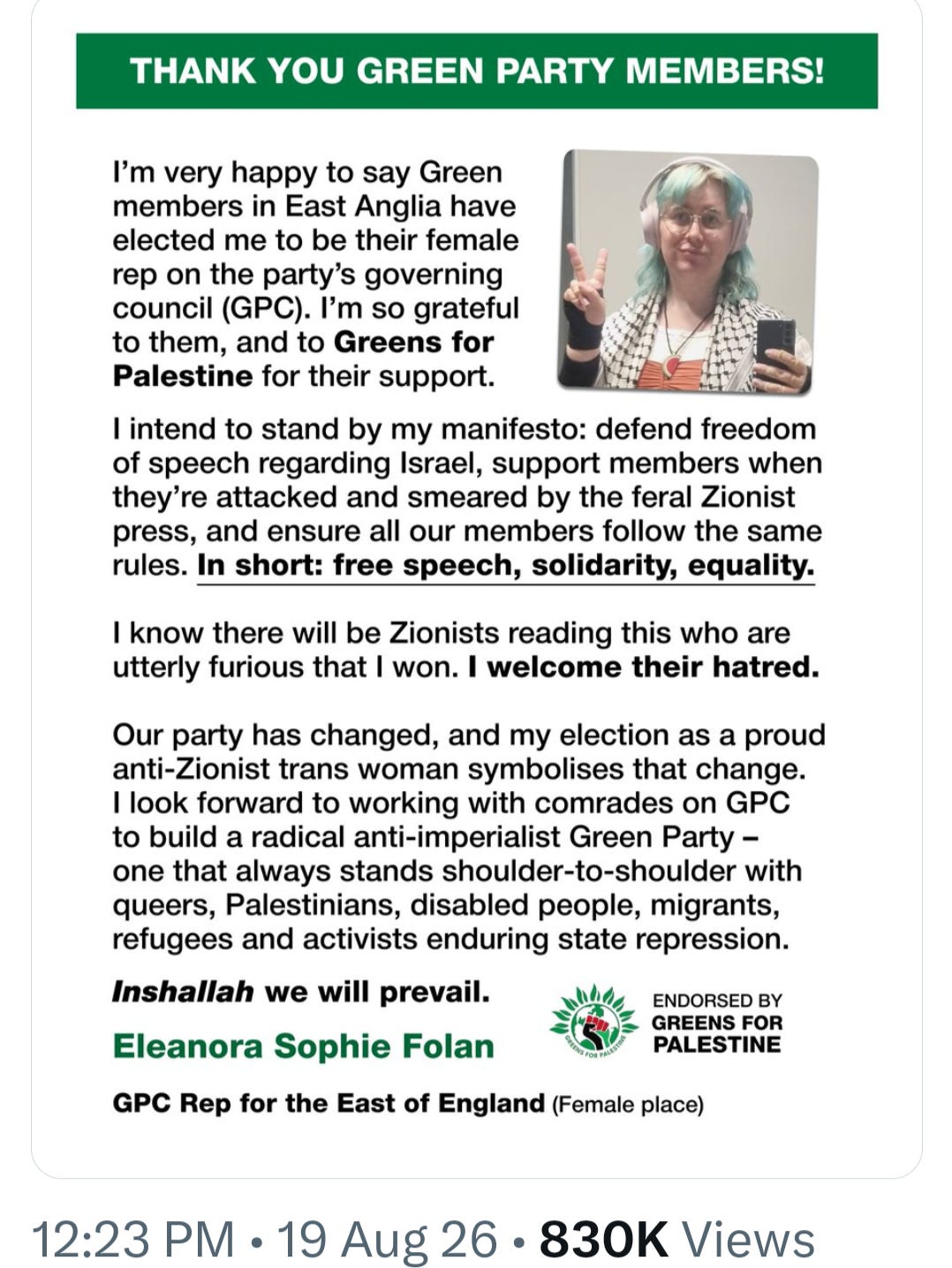
Palestine is not the problem here. The destruction of Gaza, the occupation and the extraordinary indulgence shown towards the Israeli state by much of the British political establishment demand serious opposition. Nor does the problem lie in Folan being trans, or in solidarity with migrants, refugees or disabled people. Anyone using this statement simply as another opportunity to attack trans people has misunderstood what is politically interesting about it. What catches the eye is the conception of politics underneath the words. Society barely appears. There are identities, enemies, solidarity and declarations of ideological allegiance, but very little sense of the material relationships through which most people actually experience power.
The list is revealing precisely because everyone on it may have perfectly legitimate claims upon solidarity. Yet workers somehow disappear. So do tenants, low-paid carers, warehouse staff, cleaners, teachers, delivery drivers and millions of people whose lives are organised around selling their labour and paying somebody else for somewhere to live. Employers are absent too. There are no landlords, shareholders, investment funds or corporations. Wages, rents, profits and ownership vanish from the political picture. Class has not been argued against. It has simply slipped out of view.
This matters because class was never supposed to be another identity to place alongside race, sexuality or gender. It describes a social relationship. Somebody can hate the description “working class”, change their accent, buy a house, vote Conservative, Green or Reform and regard themselves culturally as middle class, but if their ability to live still depends upon selling their labour to people who own or control productive resources, the relationship has not disappeared. Socialist politics grew from the recognition that people who looked different, worshipped differently, came from different countries and lived different private lives could nevertheless share material interests strong enough to organise around.
Much contemporary radical politics has reversed that movement. It begins with separate identities and tries afterwards to assemble them into a coalition. The vocabulary sounds expansive because the list can always be extended, but the underlying politics becomes narrower. The question ceases to be what relationships hold society together and who benefits from them. It becomes who has been recognised, who has been excluded, who has spoken incorrectly and who belongs on which side. The result can look intensely political while avoiding some of the oldest political questions of all: who owns the land, who owns the workplace, who controls investment, who receives the wealth produced by other people’s labour and what institutions would allow those without property to exercise power collectively?
“I welcome their hatred” belongs to another development that has damaged the left. It is the language of politics formed inside social media, where the anger of the opponent becomes evidence of one’s own righteousness. Trump understood this perfectly. His supporters enjoy liberal outrage because upsetting the people they despise is treated as a political achievement in itself. The content on the left is often radically different, but the emotional mechanism can be remarkably similar. If the correct people hate you, you must be doing something right.
Politics organised around that satisfaction has little incentive to persuade. Indeed persuasion starts to look suspicious because persuading people usually requires entering their world, understanding why they believe what they believe and speaking in language they recognise. Much safer to address the people who already agree with you and allow the enemy to provide the applause line by becoming angry. Social media rewards this. Anger circulates quickly, denunciation creates engagement and every hostile response confirms the original performance. Politics becomes a series of signals sent between mutually antagonistic communities.
The phrase “feral Zionist press” shows where this can lead. There is a serious material critique to be made of British media coverage of Israel and Palestine. It can identify newspaper proprietors, editors, lobbying networks, political pressure, commercial interests and specific failures of reporting. That requires evidence and precision. “Zionist press” replaces those concrete relationships with a politically homogeneous category, while “feral” supplies the emotional charge. The description feels more radical while actually explaining less. Worse, it moves towards a conspiratorial vocabulary in which public life is imagined as being controlled by a shadowy ideological network rather than by identifiable institutions, owners and political interests. The left should be exceptionally wary of that language.
Zionism is an ideology and a political project. It can be opposed and criticised without restraint in the same way as any other nationalist ideology. Israeli state violence can be condemned without euphemism. But describing “Zionists” as an undifferentiated enemy whose hatred is to be welcomed shifts the argument from analysing institutions and political projects towards constructing hostile populations. The radical right performs the same manoeuvre with migrants, Muslims and “globalists”. Different politics, different targets, but a related habit of thought: complicated structures are reduced to morally contaminated groups.
While this political culture has developed, the material world has hardly stood still. Rents have risen, home ownership has moved further out of reach, public services have deteriorated and wealth has become more concentrated. Work has become insecure for millions. Artificial intelligence threatens to reorganise employment while the technology and infrastructure remain overwhelmingly in private hands. Energy remains a source of private profit even though nobody can live without it. Young people are asked to pay extraordinary rents while being told that economic independence should arrive later and later in life. None of this is speculation. These conditions are producing the anger from which the next political settlement will be made.
The radical right has been much better at entering that space, even though the answers it offers are frequently fraudulent. Reform UK and Restore Britain tell people that houses are scarce because migrants take them, wages are weak because foreigners undercut them and public services are collapsing because outsiders consume resources that belong to the native population. This explanation leaves landlords, property developers, employers, asset owners and decades of deliberate state policy remarkably untouched. Its political usefulness lies precisely in taking real experiences of insecurity and supplying the wrong culprit.
A left that replies in the language of ever more finely differentiated identities makes the right’s job easier. Rupert Lowe does not have to establish that every Green activist thinks like this, any more than Reform has to provide a serious account of the housing market. An image such as Folan’s can simply be placed before somebody struggling with rent, worried about their children’s prospects or unable to get a GP appointment and offered as evidence of what “the left” supposedly cares about. The caricature is unfair, but sections of the left have spent years producing material that allows the caricature to work.
There is no need to abandon any of the people listed in Folan’s statement to escape this trap. Migrants are workers. Disabled people require decent incomes, secure homes, properly funded public services and control over their own lives. Trans people need housing, healthcare, employment and protection from discrimination. Palestinians need freedom from occupation and from the political, military and economic structures sustaining their dispossession. Bringing class and material power back into the argument does not weaken these struggles. It gives them somewhere to go beyond recognition and solidarity.
Even “anti-imperialism” becomes woolly when detached from material analysis. Imperialism is not just a moral description for bad things done by Western governments. It involves states, capitals, military systems, resources, markets and rival concentrations of power. An anti-imperialism that knows in advance which camp contains virtue soon ceases to be analysis at all. The point is to understand the structure of domination, including when states opposing Washington pursue their own imperial interests. Otherwise anti-imperialism becomes another badge worn inside a political subculture.
Race, sex, sexuality and nationality cannot simply be collapsed into class. Their histories are real, their forms of oppression have their own mechanisms and Marxism becomes useless when it treats them merely as tricks played by capital upon workers who would otherwise recognise their identical interests. But the opposite mistake is now much more common in parts of the left. Class becomes one oppression among several, or disappears altogether, leaving no account of the relationship around which capitalist society is organised.
As I have said many times, the old socialist questions remain powerful because capitalism has not found a way to abolish them. Who owns what? Who works for whom? Who decides where investment goes? Who receives the surplus? Why can somebody become richer because another person needs somewhere to live? Why should technologies created through enormous collective bodies of knowledge become the private property of a handful of companies? These questions are not nostalgic remnants of an industrial world that has disappeared. They run straight through the housing crisis, artificial intelligence, climate change, insecure work and the privatisation of everyday life.
That is why a small Green Party victory statement is worth more attention than it might initially seem to deserve. Not because one activist represents the left, but because the language represents a recognisable political tendency. It is a politics highly accomplished at naming identities, expressing solidarity and identifying enemies, yet increasingly uncertain about how to describe the economic relations connecting people who otherwise have little in common.
The right is trying to fill that absence with nation and ethnicity. It tells workers that their enemy arrived on a small boat rather than sitting on the board of the company employing them or owning the house in which they live. That story is powerful because it converts economic insecurity into a visible enemy. It cannot be defeated by producing a different list of enemies and a more virtuous collection of identities.
The left needs to recover the harder ambition that once defined it: taking people divided by culture, race, sex, nationality and countless other experiences and building a common politics around material interests without pretending those differences do not exist. That requires organisation rather than recognition, explanation rather than denunciation and a serious account of ownership and power. A politics that cannot tell millions of people who work for a living where they fit into its picture of society should not be surprised when somebody else does.
Thanks for reading Anti-Capitalist Musings. It is a small operation, and I hope it offers something worth your time. There will be no premium subscriber content here: everything published will remain free to read. If you value these pieces and want to support the writing, buying me a coffee helps fund media subscriptions and the books that keep the analysis grounded. Every contribution, however modest, is genuinely appreciated.