
The Managed Decline
From workshop to service counter to nothing

I visit my parents most weeks. The routine is fixed: a coffee and an argument about who is destroying the country. This week my father had settled once again on Ed Miliband. The energy secretary, he insisted, was the author of Britain’s misfortunes. The net zero obsession. The war on motorists. The general sense that everything costs more and works less. Factories closing up and down the country. I told him he needed to go back further. Much further. Miliband is a symptom. The disease was contracted decades ago, and the people who infected us are long since retired to the Côte d’Azur or buried in village churchyards with grateful obituaries in the Telegraph.
The disease has a name. It is called deindustrialisation. Britain caught it worse than anyone.
Between 1979 and 1990, British manufacturing employment fell from 6.8 million to 4.5 million. By 2010, it had halved again. This was not a natural process, like the changing of seasons or the silting of harbours. It was policy. Explicit, deliberate, ideologically driven policy. The factories did not close because the world moved on. They closed because the government wanted them closed.
The theory was simple. Manufacturing was the past. Services were the future. The satanic mills would give way to trading floors and call centres and management consultancies. Britain would design things and market things and provide services while other countries did the grimy work of actually making them. We would be clever. We would be nimble. We would be rich.
Germany did not believe this theory. Germany kept its industrial base, protected its supply chains, invested in vocational training, maintained the link between making things and the communities that made them. France maintained strategic sectors under state protection. Britain sold everything that moved and closed everything that did not.
When workers resisted, the state answered with police charges at Orgreave and court injunctions and the full machinery of coercion. The 1984 miners’ strike was not primarily about coal. It was about whether organised labour could obstruct economic restructuring. The answer was no. The line was broken. The policy continued.
The theory held that displaced workers would find new roles. Financial services would absorb some. Retail would absorb others. Tourism, hospitality, care work, logistics. The service economy would provide.
It did provide, after a fashion. But the jobs it provided were different in kind from those it replaced.
Manufacturing work was often hard and sometimes dangerous. It was also organised. Workers had unions. They had collective bargaining. They had shop stewards and strike funds and some capacity to demand that productivity gains translate into wage increases rather than simply disappearing into profit margins. The service economy dissolved these structures. Workers found themselves isolated, casualised, subject to algorithmic scheduling and fixed term contracts. They were employed, technically. The word had simply come to mean something different.
By the 2000s, the transformation was complete. Financial services contributed more to GDP than manufacturing. London became a global processing centre for money made elsewhere. The regions that had once built ships and wove textiles became dependent on public sector employment, distribution warehouses, and the circulation of consumer spending that flowed from London like blood from a heart that no longer cared whether the extremities survived.
The politicians celebrated. Britain had modernised. We were a knowledge economy now. The creative industries would flourish. Education would expand to produce graduates for the new dispensation. Anyone left behind simply had not adapted quickly enough.
The financial crisis of 2008 might have prompted reconsideration. It did not. The banks were rescued. Austerity was imposed on everyone else. The fundamental model remained unchanged. If anything, the post-crisis years accelerated existing trends. Public sector employment contracted. Gig economy platforms proliferated. The labour market became more fragmented, more precarious, more dependent on forms of work that required physical presence but offered nothing else.
This last feature matters. The service economy divided into two tiers. One tier handled complex symbolic tasks: finance, law, consulting, media, technology. These workers commanded high salaries and some degree of security. The other tier performed in-person services: cleaning, caring, serving, delivering. Their bodies remained necessary only as physical anchors for transactions. These workers stayed employed because someone had to be present in a specific location at a specific time. Nothing more.
The first tier is now exposed to artificial intelligence. The second tier is exposed to continued immiseration. Neither has the organisational capacity to resist.
And what of the manufacturing that survived? It is dying now. Some of it is already dead.
In September 2024, Tata Steel shut the last blast furnace at Port Talbot, ending over a century of primary steelmaking in Wales. Three thousand jobs gone directly, thousands more in the supply chain. The town had been making steel since the Victorian era. It will not make steel again. The replacement is an electric arc furnace, due to open in 2027, that will employ a fraction of the workforce and depend on scrap metal imports rather than domestic production. This is not transition. It is managed diminishment dressed in the language of green investment.
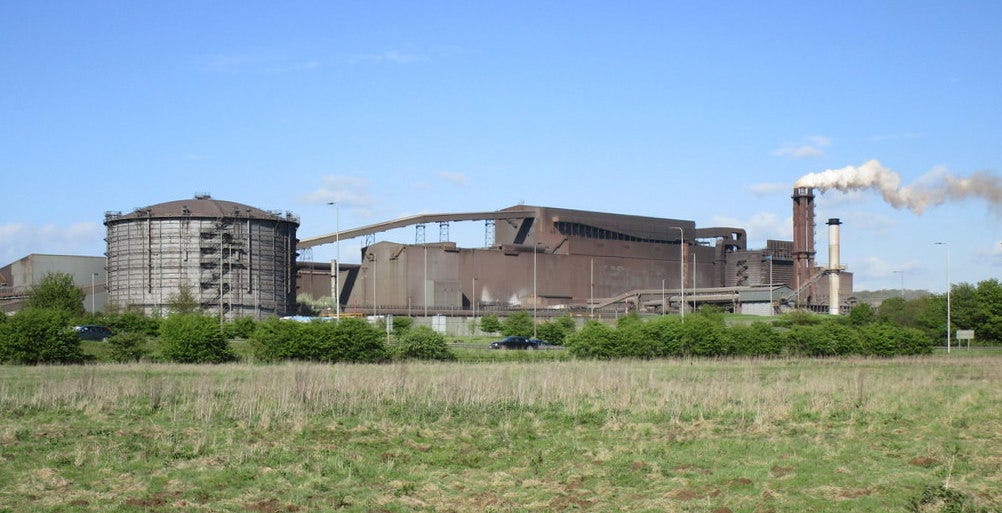
Six months later, British Steel’s Scunthorpe works nearly followed. In April 2025, the Chinese owner Jingye Group announced it would stop buying raw materials for the blast furnaces, which were losing seven hundred thousand pounds per day. Parliament was recalled on a Saturday. Emergency legislation passed in a single day. The government took operational control of the plant to prevent the furnaces from going cold, because once a blast furnace stops, it is ruinously expensive to restart. The Steel Industry (Special Measures) Act 2025 gave ministers powers to direct operations, secure raw materials, and maintain production. Nationalisation, the Business Secretary admitted, was a “likely option.”
This is where we are. The last blast furnaces in Britain kept running only because the state intervened at the final hour. The country that invented the Bessemer process, that built an empire on steel, now cannot produce virgin steel without emergency government direction of a Chinese-owned company. If Scunthorpe closes, Britain becomes the only G7 nation unable to make steel from raw materials.
The causes compound. Energy costs in Britain run fourteen to twenty-five per cent higher than in France and Germany. UK Steel calculates that British steelmakers have paid eight hundred and forty-five million pounds more for electricity than their French competitors since 2016. The wholesale price is only part of it. Network charges, policy costs, the legacy of a privatised system designed to extract value rather than provide capacity: these add layers of expense that make energy-intensive manufacturing unviable. A steel plant, a glass factory, a ceramics works: each must pay more for every unit of power than its European competitors. The arithmetic is remorseless. The Office for National Statistics reports that output in energy-intensive manufacturing has fallen by a third since 2021 and now sits at its lowest level since records began in 1990.
Brexit adds friction at every border. Components that once moved freely now require customs declarations, rules of origin documentation, phytosanitary checks. The delays add cost. The uncertainty adds more. Manufacturers who relied on just-in-time supply chains discover that just-in-time does not function when lorries queue at Dover. Some have moved production to the continent. Others have simply closed.
And Trump’s tariffs arrived in 2025. Twenty-five per cent on steel and aluminium. British Steel was already fragile; the tariffs affected five per cent of its annual exports, worth approximately half a billion dollars. Investment decisions are deferred because no one knows what the rules will be in six months. Capital seeks stability. Britain offers none.
Even if we solved every self-inflicted problem, even if energy costs fell, even if Brexit were reversed, even if Trump were replaced by a free-trade evangelist, we would still face China. Chinese steel costs less to produce than British steel. Chinese manufacturing operates at scales and subsidies that no market economy can match. The Chinese state treats industrial capacity as a strategic asset, a matter of national security, a foundation for military and economic power. Britain treats industrial capacity as a line item to be optimised, a legacy sector to be managed into oblivion, an embarrassment from a past we have been taught to despise.
The factories that survived deindustrialisation are not surviving globalisation. The manufacturing base is not a remnant waiting to be rebuilt. It is a corpse being picked clean.
The knowledge economy was a class bargain. The state made an offer to the middle class: accept deindustrialisation, accept the destruction of organised labour, accept the hollowing out of the regions. In return, your children will be safe. They will go to university. They will acquire degrees. They will work in offices rather than factories, and their position will be secure.
A generation accepted this bargain. They took on debt to fund degrees. They deferred earnings through extended education. They accepted unpaid internships and entry-level precarity as the price of eventual stability. The credentials were insurance against the chaos below.
The bargain is now being revoked. The same class interests that offered it are withdrawing it.
Morgan Stanley published a report this month. British businesses have cut eight per cent of jobs net since large language models became widely available. American businesses, over the same period, created jobs despite similar productivity gains. The difference is not mysterious. America retained more diverse economic structures. Defence industries, technology manufacturing, energy production, agriculture at scale. The American service economy grew alongside other sectors rather than replacing them.
Britain placed its bets entirely on services, then discovered that the specific services it specialised in are precisely those most amenable to automation. Legal research. Financial analysis. Customer service. Content production. Administrative processing. These workers do not produce. They process. They are the human middleware of the economy, translating inputs into outputs according to established procedures.
Large language models do this work adequately. They do it cheaply. They do not require salaries or holidays or sleep. The humans become redundant.
The workers most at risk are not those doing manual labour. They are the credentialled processors who believed their degrees would protect them. The Morgan Stanley data is specific: early-career positions face the highest risk of elimination. Senior professionals have institutional position and client relationships that cannot easily be replicated. Junior professionals have skills that can be replicated at lower cost by systems that never tire and never ask for raises.
The generation that paid most for the credential bargain will receive least from it.
Sadiq Khan gave a speech last week warning of mass unemployment. He spoke of moral duty. He spoke of intervention. Jamie Dimon told Davos that governments would need to act to prevent civil unrest. These statements share a grammar. Something must be done. We must act. Steps must be taken.
The passive voice obscures agency. Who, precisely, is meant to do what?
The large language models now displacing workers were trained on the accumulated text of human civilisation. Wikipedia. Reddit. Academic journals. News archives. The creative output of a species, hoovered up and fed into pattern-matching systems without consent, without compensation, without acknowledgment. The underlying research emerged from publicly funded universities. The infrastructure depends on energy grids and communication networks maintained through public investment.
Yet the productivity gains flow almost entirely to technology companies and their shareholders. The workers whose output was scraped to create training data receive nothing. The workers displaced by deployment receive the option to retrain for jobs that may not exist.
This is not a natural disaster. It is an outcome.
Alternative arrangements are possible. Productivity gains could be distributed through shorter working hours rather than fewer workers. Automation could be treated as a public utility, with access and benefits determined collectively rather than by market position. Transition costs could be borne by those who profit from displacement rather than those who suffer it. The technology itself is not the problem. The problem is who owns it, who controls it, and who captures its benefits.
But these responses require forms of organisation and political power that were systematically dismantled during the decades of deindustrialisation. The same policies that destroyed manufacturing unions left service workers atomised and precarious. The same logic that demanded flexibility from labour insulated capital from any reciprocal obligation. There is no organised force capable of demanding a different distribution.
The working class was broken in the 1980s. The middle class was bought off with degrees. Now the degrees are losing value and there is no working class left to join. The children of the compromise discover that their parents were not protected. They were simply next in line.
I will see my father next week. He will have found a new villain. Perhaps Rachel Reeves. Perhaps Keir Starmer. Perhaps some BBC presenter who said something irritating about climate change. Who am I kidding, it will still be Ed. But, I will listen, as I always do. And I will not tell him what I actually think, which is that the people who did this to us are beyond his anger’s reach. They are dead, or retired, or sitting in the House of Lords collecting attendance allowances. They will never face consequences. They do not even face criticism, because the catastrophe they engineered has been naturalised. It is simply how things are. It is simply the way the world works.
Britain built an industrial economy over two centuries. It destroyed that economy in two decades. It replaced it with services. Now it discovers that services can be automated too.
There is nothing underneath. There was always nothing underneath. The services were not a foundation. They were a platform suspended over a void, and the platform is beginning to give way.
The fall will not be dramatic. It will not be sudden. It will be the same grey managed decline we have been living through for years, only faster, only more complete. The young will emigrate. The old will grow poorer. The middle will discover that they can buy less with each passing year. And somewhere, in an office that used to employ fifty analysts, a large language model will process queries at a fraction of the cost, and no one will remember what it replaced.
At some point during the visit, my mother will remind me that she once met Nigel Farage. She always does. “Horrible man,” she will say, with the quiet certainty of someone who has taken his measure in person and found him wanting. Well. At least that is one fewer Reform vote from their target demographic.
Happy retraining.
Against capital, against empire, against forgetting.
Notes and essays from the wreckage of the present.