
The Wrong Instrument
ASLEF excluded BNP members in the 1990s on grounds of structural incompatibility with trade union solidarity. That instrument still exists. The question is whether the FBU recognises it before Reform.

Thanks for reading Anti-Capitalist Musings. It is a small operation, and I hope it offers something worth your time. There will be no premium subscriber content here: everything published will remain free to read. If you value these pieces and want to support the writing, buying me a coffee helps fund media subscriptions and the books that keep the analysis grounded. Every contribution, however modest, is genuinely appreciated.
The Greater Manchester Fire and Rescue Service sent an email in April. Carl Petch and Humaira Ahmed, the joint heads of its race and faith staff network, wrote to firefighters noting that some colleagues had chosen to stand as Reform UK candidates in local elections, and that the service was seeking legal guidance to protect its inclusive culture. By June the Daily Mail had it, Zia Yusuf had written formally to the Chief Fire Officer with eight demands and a FOI threat attached, the Free Speech Union was calling it chilling, Paul Embery was calling it an overstep, Lee Anderson had posted the headline with a single word beneath it, and Suella Braverman had used the moment to call for the repeal of the Equality Act. Reform had turned one clumsy internal email into a national story about institutional persecution of their voters. The story will run for months.


The email was badly judged. Not because firefighters should face no consequences for their political affiliations. Because it reached for diversity and inclusion language to address a political problem, and that is the institutional equivalent of turning up to an argument with a form. Diversity frameworks are managerial instruments. They explain outcomes in terms of institutional culture and protected characteristics. They are not equipped to address a party that has voted against every piece of workers’ rights legislation a Labour government has brought forward, and they give the opposition exactly the language it needs: inclusive culture, race and faith networks, DEI agenda. Reform did not construct that framing. Petch and Ahmed handed it to them.
The deeper problem is that GMFRS should not have been holding any instrument at all. Electoral neutrality rules exist precisely to prevent employers from intervening in the political affiliations of their staff during a regulated election period. Yusuf’s letter understood this, which is why it hammered the electoral neutrality angle rather than the free speech one. That framing was available because the employer had no standing to act. The body with standing was the FBU. A union can set its own membership criteria. A union can say that standing for a party which has voted against the Employment Rights Bill is incompatible with membership, and it can ground that argument in precedent. An employer cannot do any of those things without handing the opposition a story about institutional persecution. GMFRS did not just reach for the wrong instrument. It picked up an instrument that did not belong to it and left the right one sitting on the table. Reform built its victim narrative in the gap between the two.
ASLEF made the right argument and it is still available, though the history of how they got there is more complicated than the union movement generally remembers. When Jay Lee, a train driver and BNP candidate in the 2002 Bexley local elections, was expelled from ASLEF for his BNP membership, the union lost the first round. An Employment Tribunal ruled in May 2003 that ASLEF had breached section 174 of the Trade Union and Labour Relations (Consolidation) Act, which prohibited expulsion solely on the grounds of membership of a political party. The Employment Appeal Tribunal overturned that in January 2004 and sent the case back. A new tribunal ruled for Lee again in October that year, awarding him £5,000. ASLEF took it to Strasbourg. The European Court of Human Rights found in the union’s favour in February 2007, ruling that the domestic provisions interfered with ASLEF’s right of free association under Article 11, and that the union’s right to choose its members outweighed Lee’s claim.
The legal distinction that ran through every stage of the case is the one that matters now. The question throughout was whether Lee had been expelled for being a BNP member, which domestic law prohibited, or for his statements, acts and omissions, which was lawful. ASLEF ultimately prevailed on the conduct argument, not the membership argument. That distinction is precisely what the FBU has available and has not used. Reform MPs voted against the Employment Rights Bill. They opposed every piece of workers’ rights legislation Labour brought forward. A firefighter standing as a Reform UK candidate is standing for a party whose programme would strip FBU members of the protections the union was built to defend. That is a conduct argument. It is grounded in the party’s voting record, not its cultural tone, and it does not hand Yusuf a free speech story. The GMFRS email reached for the wrong instrument. The right one is sitting in a 2007 ECHR judgment.

Pete North is not a source I would ordinarily cite at length. He writes from somewhere in the civic nationalist right, is impatient with the ethnonationalist tendency, and published a thread on the Restore Britain internal schism that is more analytically useful than most of what the left has managed on the same subject. His diagnosis: the online support base leans hard toward ethnonationalism, the casual membership is hardline anti-immigration conservative, and Rupert Lowe does not think deeply about ideology. The ethnonationalists want Restore Britain named explicitly as an ethnonationalist party. The party cannot do that without losing the civ-nat vote. So it runs a Faustian pact, tolerating the worst of the online base in exchange for their activism. North calls it a Trojan Horse. He thinks it cannot last.
He is right about the structure. His account of the direction of contamination is where the analysis breaks down.


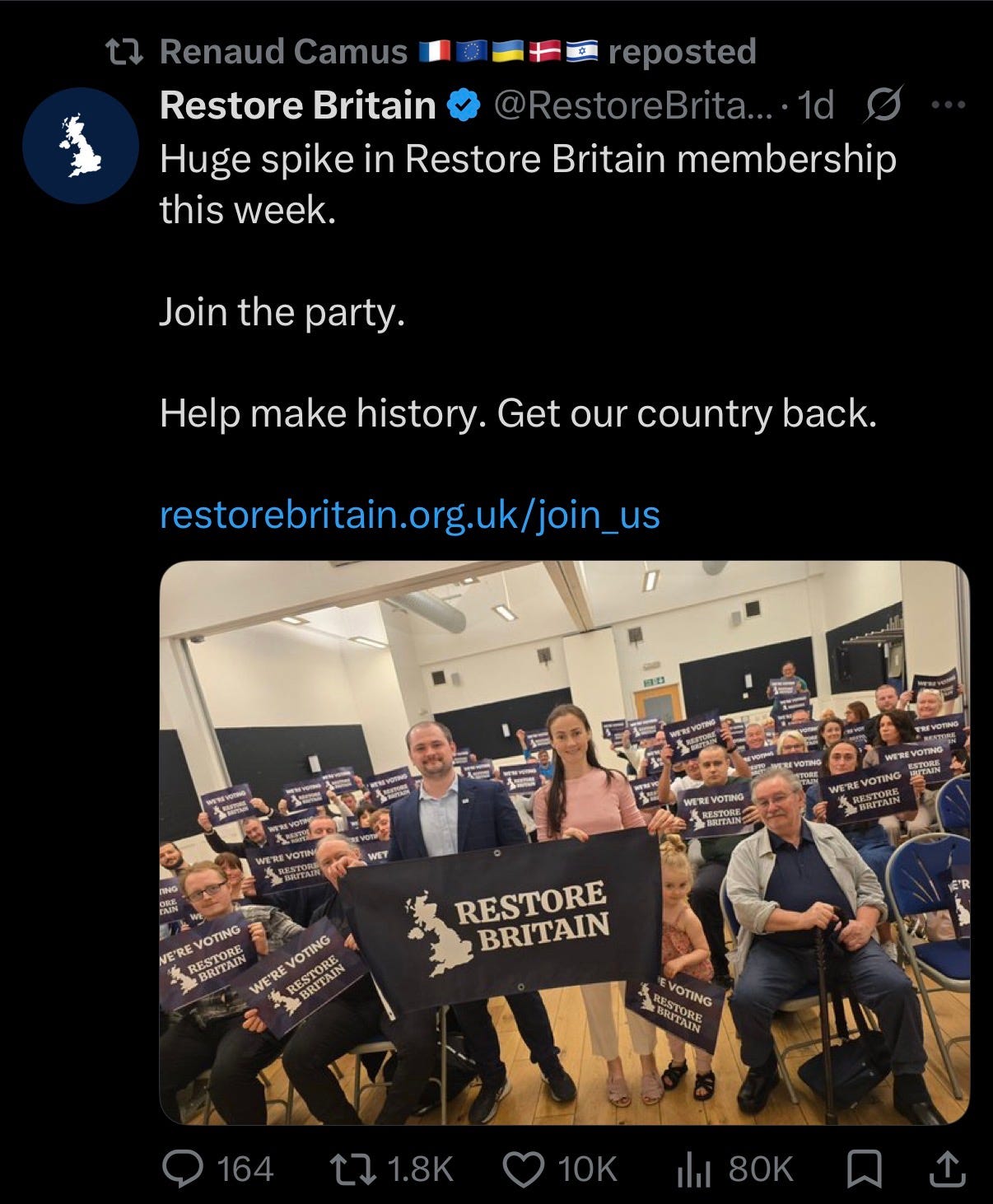
The ethnonationalists are not a foreign body that has entered a viable civic nationalist project. They are the operating engine. Hugh Anthony saw a photograph of two Restore Britain candidates, one Black and one of South Asian heritage, and posted: an African refugee and a half-breed Pakistani man, deport both of them. Steve Laws reposted news of Rupert Lowe’s deportation flight investment comment and added his own thread from February 2025, arguing that the easiest way to carry out remigration is to privatise it, just as they did for immigration, and that it does not matter if it takes a year or ten as long as the job is done. The Núcleo Nacional, a Portuguese neo-fascist organisation, is circulating torchlit march footage alongside a Henry Nowak “presente” placard, the Latin American martyrdom liturgy applied to a British murder case. Renaud Camus reposted the Restore Britain membership spike. Ligne Droite covered the Great Yarmouth council results as a continental remigration breakthrough, with Paul Kentwell speaking outside the Panthéon in a Union Jack t-shirt while Lowe the same morning posted “Vote. Volunteer. Participate.” None of this is poor vetting or bad luck with candidates. It is the operating structure of the party’s coalition.


The Nowak case is a British story that has been picked up and carried far beyond it. I have been following what far-right networks do with cases like this long enough, since the BNP worked Peterborough in the 1990s, to recognise the pattern. The presente placard is not an isolated piece of content. It is a node in a network running from Great Yarmouth to Vienna to Lisbon to Paris, using a local murder to build a martyrology across borders. The network has been doing this for thirty years and longer. The novelty is the speed.
This is where the analysis has to hold something open rather than close it. Restore Britain is not a fascist party and Rupert Lowe is not a fascist. That matters analytically because the response that follows from a correct description is different from the one that follows from a lazy one. What Restore Britain actually is requires a harder account: an organisation built for electoral credibility that is being colonised from within by people for whom electoral credibility is a temporary instrument rather than an end. Luke Jahn is publicly debating whether the National Reform Party is inevitable while describing Nazism as a socialism of the race, a unity of blood and spirit (and the nonsense that the Nazis were socialists). Harrison Pitt is asking Kemi Badenoch what her strategy is for turning ethnocentric third-worlders into colour-blind individualists and announcing that the days of unilateral disarmament are over. These are not Rupert Lowe’s positions. They may not be positions Lowe has registered. That gap, between what the leader projects and what the base produces, is the question this piece cannot answer cleanly.


Makerfield will begin to answer part of it. Great Yarmouth was Lowe’s own ground, built over years, with a local franchise operation already embedded in the council chamber. A strong result there told you something about what Restore Britain could do in favourable conditions. Makerfield is a different test: whether the support travels, whether the energy the online base generates converts into votes in a constituency Lowe has no personal history in, whether the party is building something transferable or something essentially personal to its leader. A strong performance confirms the private Reform assessment already circulating, that everybody has underestimated the impact of Restore Britain. An underwhelming one opens the first public distance between the leader’s positioning and what the base has been promised.
The more structurally significant event is the first national members conference, whenever it comes. Conference is where the contradiction Pete North identified has to be managed in a room rather than on a timeline. Motions, platform access, what the membership passes against the leadership’s preference: all of that is visible in ways that a social media base is not. The ethnonationalist core is highly organised and motivated. The casual civ-nat membership is larger but softer. In any conference the organised minority tends to win unless the platform maintains tight procedural control over what reaches the floor. Lowe will need either that control, or a willingness to confront his own base publicly in a way he has not yet had to. The conference will not resolve the Faustian pact. It will be the first moment where the pact becomes institutional rather than merely rhetorical, and where the cost of running it becomes visible to everyone in the room.
Reform, starting the week, are running a different operation entirely. Yusuf’s letter to Chief Fire Officer Dave Russel runs to two pages and eight specific demands. It invokes the Electoral Commission, HMICFRS, and the Freedom of Information Act. It gives GMFRS a deadline and states that non-compliance will trigger FOI action. That is the work of a party that understands which institutional levers matter. The Burnham story did not happen by accident: it was built from the email, the Daily Mail exclusive, the formal letter, and the free speech chorus that followed. This does not make Reform or Farage fascist. It makes Reform dangerous in the specific way a credible hard-right party with a functioning parliamentary operation is dangerous, occupying institutional terrain while the trade union movement is still reaching for frameworks that explain political problems in terms of inclusive cultures.
The ASLEF precedent took five years and an ECHR judgment to establish. The FBU has not used it. Reform understands which instruments work. The question is whether the union movement can recognise the ones it already holds before the other side finishes building the case against it.
Thanks for reading Anti-Capitalist Musings. It is a small operation, and I hope it offers something worth your time. There will be no premium subscriber content here: everything published will remain free to read. If you value these pieces and want to support the writing, buying me a coffee helps fund media subscriptions and the books that keep the analysis grounded. Every contribution, however modest, is genuinely appreciated.