
They Have Only Changed the Word
“Strip away the polo shirts and the European summits and remigration is the demand the National Front made in 1972: remove people by descent. The line about protecting one’s own people is the same.

Thanks for reading Anti-Capitalist Musings. It is a small operation, and I hope it offers something worth your time. There will be no premium subscriber content here: everything published will remain free to read. If you value these pieces and want to support the writing, buying me a coffee helps fund media subscriptions and the books that keep the analysis grounded. Every contribution, however modest, is genuinely appreciated.
“It’s not about hatred for others but love for their own.”
That is the script now, recited in a calm and faintly academic register by young men in fitted polo shirts and blonde haired women who have skimmed some Heidegger and absorbed a great deal of YouTube history and philosophy. Remigration, they will tell you, has nothing to do with supremacy. It concerns peoplehood, belonging, the right of a nation to go on being itself. The cattle-truck connotations belong to the past. What they propose is calm and humane, a matter of incentives and the tidy correction of a demographic mistake.


Away from the lectern the same movement says the opposite, and says it at volume. On the 9 June its supporters ran a pogrom through Belfast, going door to door with lists of migrant homes and burning families into the street. Online the threshold is lower still. A brown or black face, citizen or not, attached to a crime that may never have happened, and within the hour the replies arrive: remigration now, send them back. Henry Nowak’s killer was a British-born Sikh, and the relay ran at full speed regardless, because what sets it off is the colour of the accused and not the contents of his passport.
None of this is hidden from the conference. Joey Mannarino took the Porto stage on the 30 May to call remigration a moderate solution, and days later, watching the masked men in Belfast, he told his followers they had the right idea. Steve Laws works the same seam closer to the surface, which is why the Porto organisers left him in the audience while the media-friendly went up to speak. The polish and the petrol belong to one project, and the register it reaches for depends on who is listening.
Strip the varnish and the demand underneath has not moved an inch since 1972.
Consider where the soft register comes from. Nick Griffin spent the early 2000s teaching the British National Party one lesson: the British public would never vote for naked racial hatred, so the movement had to stop speaking it aloud. Drop the word “race.” The replacements were freedom, security, identity, democracy, concepts that polled well and gave the same content a respectable home. The demand itself stayed put, lodged in the policy of “voluntary repatriation,” the cash inducement designed to make a black or brown Briton leave the only country they had known. Griffin did not soften what he wanted. He laundered the language around it, and he said as much, more or less openly, to anyone in the party who would listen. The remigrationists inherited his marketing department wholesale.

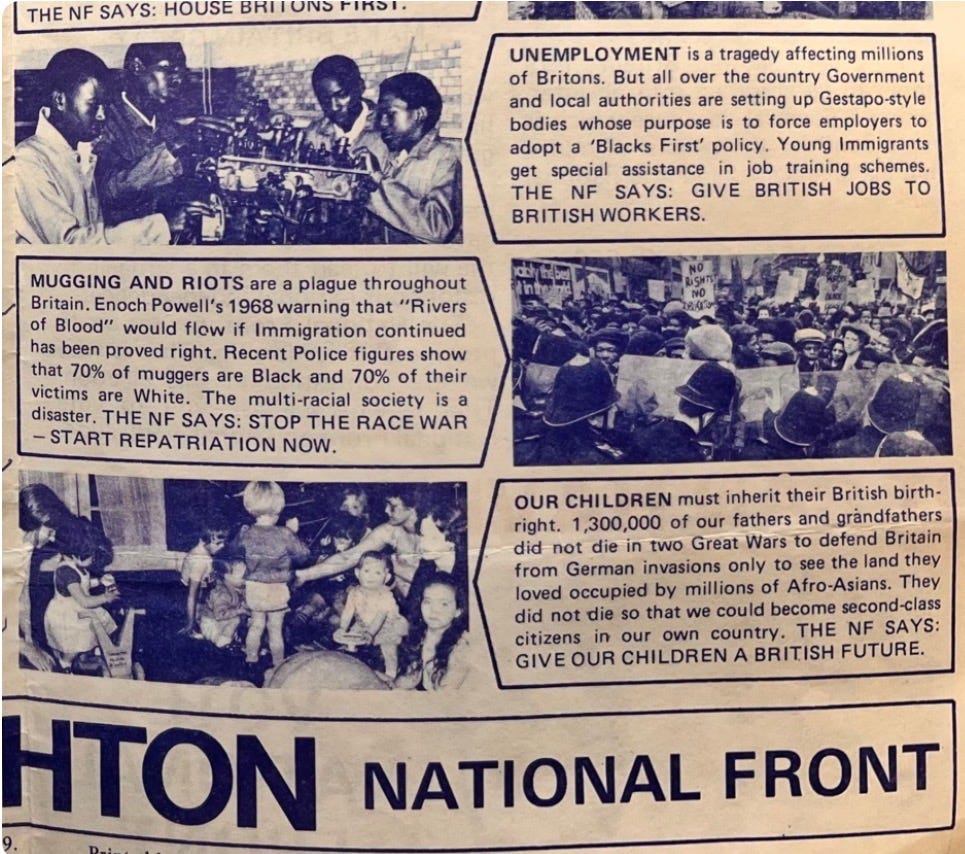
Go back another generation and the costume is cruder, the substance identical. The National Front ran through the 1970s on “Repatriation Now,” compulsory and total, the removal of every “coloured” immigrant from British soil. John Tyndall, who led it, had been photographed a decade earlier in the quasi-uniform of Colin Jordan’s National Socialist Movement, an outfit untroubled by euphemism. Martin Webster marched. Enoch Powell, from the respectable benches, had already pressed for state-funded repatriation and lent the whole business a frock coat, and the Front grew in his slipstream. None of these men called himself a hater. Each insisted he was defending a people, a homeland coming apart under strangers. The tune you are hearing in 2026 is theirs, just with better production values.
The word itself, remigration, is the giveaway. They reached for it precisely because “send em back”, deportation, and repatriation had acquired a stink. Renaud Camus supplied the theory, the Great Replacement, the fantasy that a native European population is being swapped out for another by elites who despise it. A French court has convicted him of incitement to racial hatred. Martin Sellner supplied the operational pamphlet, a book that turned the slogan into a programme. As a younger man he had stuck a swastika sticker on a synagogue in Austria. Brenton Tarrant, before he murdered fifty-one people in two Christchurch mosques, sent Sellner’s organisation a donation and titled his manifesto after Camus’s theory. This is the surface you are invited not to scratch. Scratch it anyway.
The British importers know which shelf they are buying from. Rupert Lowe’s Restore Britain has produced a deportation document running past a hundred pages, mass removal now just a matter of logistics and law. In Vienna, Harrison Pitt (Restore’s policy wonk) shared a stage with Camus and Sellner and called it a discussion about Europe’s future. Steve Laws calls for the term to be used freely. The polo shirts, the lambda, the summit in Porto, the steady talk of “the West” and “our civilisation”: the whole apparatus exists to let a respectable-sounding man advocate the racial sorting of a national population without once using a word that would make his Facebook audience wince.


The mechanism ran in public this weekend. On Saturday night the Mail on Sunday gave the Porto summit its front page, and among the British faces it named was a nineteen-year-old who posts as “Angloid” and had until then guarded his real name, Lorcan Barker. The paper hung the words neo-Nazi and white supremacist on him. Barker’s reply, up within hours, swung between defiance and self-pity and never once stepped off the script. They had wrecked his life and his work, he said, printed his full name in a paper his own family reads. And then the sentence, offered as though it closed the matter: all he does is advocate the right of his people to a homeland of their own. Scratch that and you reach Raise the Colours, the trips to Calais to harass asylum seekers and the volunteers feeding them, the ban from France, the friends who extend “remigration” to British Jews. Rupert Lowe waved the whole report away as proof the establishment was frightened. Underneath the homeland talk sits the record, and the record is what he is actually asking for.


The remigration movement has moved on from the National Front: more sophisticated, better funded, organised across borders, a table at the EU, fluent in the grievance-language of the disaffected graduate as much as the angry suburban gran. Not everyone it attracts keeps a swastika flag in the attic. The movement runs on careerists, podcast-chasers, lonely young men and a few sincere cranks, and only a minority at its core would pass for the genuine Nazi article. I cannot prove the worst about every person who has reached for the word, and I will not pretend to. The test was never the dressing up box or the reading list. It is the demand. And the demand, made by Tyndall in a uniform and by Sellner in a polo shirt, is that the state mark out a category of human being by descent and remove them. Whoever makes that demand does the Front’s work, whatever he calls it, whatever she has read.
Stuart Hall spent a career on the mechanism underneath all this, the way race becomes, in his phrase, the modality through which a whole politics is lived and felt. Ethnonationalism performs a particular trick, a sleight of hand, or naturalisation if you want the academic word. It takes a political choice, who belongs and who does not, who counts as a real member of the nation, and re-describes it as a fact of blood and soil, a law of nature rather than a decision somebody made and somebody else could unmake. “Protecting one’s race” is that choice stated as destiny. There is no defensive, non-supremacist way to sort a population by descent and expel the wrong kind. The sorting is the supremacy.
I have watched the costume change once before, close up. In Peterborough in the late-1990s/early 2000s the BNP I argued with, still used the word race without embarrassment; the men pushing leaflets through the letterboxes of the old railway cottages did not yet know they were meant to talk about identity instead. The vocabulary improved and the leaflets got glossier. What the leaflets asked for never changed, and some of the faces behind them did not change either.

So I am not interested in being told that remigration is a serious idea owed serious engagement, or that the comparison to the National Front insults thoughtful Europeans who have never broken a window. The window-breaking was always a minority sport. The demand was the point, and the demand has outlived three brand identities, the jackboot and the suit and now the polo shirt, because the people making it find a new word the moment the old one starts to smell. Repatriation went off. The voluntary version lasted a little longer before it too began to reek. Remigration is fresh for now, clean in the mouth, and it will last only as long as it takes the rest of us to remember what it stands in for. The genealogy is not a coincidence and it is not a smear. It is the inheritance, handed from Jordan to Tyndall to Griffin to Sellner, and the men and women holding it now would like you to believe they found it new in the road. They know where it came from. So could the rest of us, with less effort than the pretence requires.
Thanks for reading Anti-Capitalist Musings. It is a small operation, and I hope it offers something worth your time. There will be no premium subscriber content here: everything published will remain free to read. If you value these pieces and want to support the writing, buying me a coffee helps fund media subscriptions and the books that keep the analysis grounded. Every contribution, however modest, is genuinely appreciated.