
Warning Without Remedy
Odd Arne Westad and the Limits of Grand Strategy

Thanks for reading Anti-Capitalist Musings. It is a small operation, and I hope it offers something worth your time. There will be no premium subscriber content here: everything published will remain free to read. If you value these pieces and want to support the writing, buying me a coffee helps fund media subscriptions and the books that keep the analysis grounded. Every contribution, however modest, is genuinely appreciated.
There is a memorial near the village of Thiepval in Picardy, fifty metres tall, rising above the river Ancre. On its walls are the names of more than 72,000 British soldiers whose bodies were never recovered from the Somme. Odd Arne Westad opens The Coming Storm here, and the choice is revealing. The monument is vast, specific, and overwhelming. It is also, as Westad notes, accidental-looking: “a bit like a set of gigantic Lego bricks, put together hastily and abandoned in that shape when play ended.” He means this as a metaphor for the war itself: inadvertent, haphazard, the product of interlocking decisions made by older men far from the battlefield. What he does not pause on is who is commemorated. The 72,000 missing are British. Ten minutes down the road are 17,000 German dead. Indians fought at the Somme. Canadians. South Africans. A recent immigrant to Fremantle in western Australia, shipped back to Europe to die on his first day of battle. The empire is present in the monument and then, for most of the book that follows, absent as actor. It tells you what kind of book this is going to be.
Westad is the Elihu Professor of History and Global Affairs at Yale, one of the finest historians of the Cold War and modern East Asia working today. The Global Cold War, which won the Bancroft Prize, remains the definitive account of how superpower competition was conducted through the bodies of people in the Global South. The Coming Storm is a different kind of book, and the difference matters. My son gave me this book for my birthday, and I had been reading about the new German conscription rules, which gave the argument about whose children absorb the cost of Great Power miscalculation a particular sharpness. It grew out of Yale’s Grand Strategy programme, and it shows. Not in the quality of the history, which is good, but in the questions the history is asked to answer, and the questions it is not permitted to ask at all.
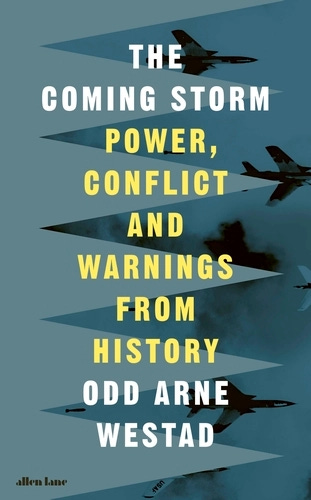
The book’s central argument is a historical analogy. The world of the early twenty-first century, Westad contends, resembles not the immediate pre-war world of 1912 but the longer arc from 1870: the period of declining British hegemony, German rise, multipolar scrambling, accumulating nationalist resentment, and the gradual degradation of the diplomatic architecture that had kept the Great Powers from each other’s throats since Waterloo. “The period of the late nineteenth to the early twentieth century,” he writes, “with its long period of Great Power peace, its declining British hegemony, its multiplicity of rival powers, its globalizing economy, and its new forms of imperialism, nationalism, and racism, is not identical to our own time but shows strong similarities to it.” The Cold War was too bipolar to serve as a useful mirror. The interwar period was too deformed by the consequences of the first catastrophe to illuminate the approach to it. The forty-four years from German unification to the assassination in Sarajevo are the relevant precedent.
This is a better frame than most commentators reach for, and Westad uses it with real precision. The starting point is not the July crisis but Bismarck’s 1862 speech to the Prussian parliament: “the great questions of the time are not decided by speeches and majority decisions… but by iron and blood.” From that point forward, Westad traces the structural conditions that made 1914 not inevitable but probable: the rise of the new power, the anxiety of the established one, the decaying empire clinging to a stronger ally, the resentful secondary power seeking revenge. If the analogy holds, we may be closer to 1890 than to 1912. The fears and resentments are accumulating. The crisis mechanism has not yet clicked into place. That is not reassurance. It means there is time, but only if the time is used for a diplomatic architecture that current political conditions make almost entirely unavailable.
The then-and-now structure Westad builds is, at its best, genuinely illuminating. Britain’s actual position before 1912 was stronger than its political class believed: “Its GDP per capita was on the rise, as was its industrial output and its levels of technology and military know-how.” The erosion was relative rather than absolute. Industrial capital, however, preferred imperial investment to domestic renewal, and the working class absorbed the cost. Relative decline, combined with wage stagnation, produced a politics of fear that operated independently of the facts. Joseph Chamberlain argued that free trade had “raised the cost of production in the country and then… allow[ed] the products of other countries… freely to enter our country in competition with our own goods.” Trump: “I am a Tariff Man. When people or countries come in to raid the great wealth of our Nation, I want them to pay for the privilege of doing so.” The political logic is structural, not accidental. Declining hegemons generate tariff politicians.
The peak-power anxiety argument is the book’s sharpest move. By 1910, some German planners were arguing that Germany was at its maximum relative power and that the window for advantageous action was closing. Westad finds the same calculation circulating in Beijing: “there is strong enough [talk] to engender talk in Beijing about China now, for economic reasons, being at the peak of its relative influence and therefore of its opportunity to rearrange its region to its advantage.” China’s hyper-growth is over, from above ten percent annually before 2010 to somewhere between two and three percent in 2024. Youth unemployment is rising. The one-child policy means China will be old before it is rich. The CCP’s crackdown on Alibaba, Tencent, DiDi drives capital offshore. Against this domestic deterioration, the nationalist imperative to complete unification with Taiwan acquires new urgency. A peak-power calculation made war thinkable in Berlin in 1914. It is in play again.
On alliance credibility, Westad is equally precise. Pre-1914 Britain maintained studied ambiguity about whether it would defend France. German planners calculated, plausibly, that Britain might stay out, which made the gamble on war look less reckless than it was. “The only factor that could have prevented a world war after the Austrian attack would have been a clear and public British commitment to support the Franco-Russian alliance.” Strategic ambiguity dissolved deterrence at the precise moment deterrence was most needed. “Given the phenomenal rise of China, there is no doubt that East Asia has to be America’s number one priority, just like Europe should have been for Britain before World War I. For declining hegemons, getting their priorities right is often the difference between peace and war.” Britain got its priorities wrong: twenty years of imperial overextension, ambiguity about the one commitment that mattered, and a continental war that destroyed its hegemony in four years. Trump’s treatment of NATO, “We have to finish the process we began under my [first] administration of fundamentally reevaluating NATO’s purpose and NATO’s mission,” replicates exactly the uncertainty that French and Russian planners felt about British intentions before 1914.
So the analogy works. The question is what it cannot see.
The first problem is the unit of analysis. Grand strategy requires treating states as coherent actors with legible national interests. Westad deploys this assumption consistently and without examination. The book’s most acute passage almost breaks through it. Writing about pre-1914 Britain, Westad observes that the main problems “were domestic, more than international, and in many ways similar to those of the United States today.” He is precise about who bore them: “the cracks mattered more for the less privileged in society, those who had worked the Industrial Revolution and fought Britain’s wars. They may not have read statistics, but they were keenly aware of what happened to their own paychecks and to the prospects of betterment for their children.” Then the passive voice arrives: “Britain had failed to strengthen those industries that provided well-paying jobs for workers.” British capital chose imperial returns over domestic investment. Lancashire mill owners preferred cheap colonial markets to retraining their workforce. The agency is not absent; it is suppressed. The class experience is noted. The class structure that produced it is not examined.
The same omission structures the arms race. Westad notes the “cult of the offensive” among military planners but does not ask who profited from the Dreadnought programme. Armstrong Whitworth and Krupp did not want diplomatic resolution. Their interests in sustained competition are not part of his analytical frame, then or now. Today’s equivalent is the revolving door between the Pentagon and the defence contractors, the think tanks funded by Raytheon and Lockheed Martin producing the strategic assessments that justify the next procurement cycle. Grand strategy cannot accommodate this. Once you ask whose interests the arms race serves, you are doing a different kind of analysis, one the Yale Grand Strategy programme is not designed to produce.
The second problem is imperialism. The empire does not disappear from the text. What the book abandons is the empire as actor. Westad acknowledges that “the twin jewels in the British system were its empire and its navy,” that it “encompassed nearly a quarter of the global population.” He notes that Germany wanted colonies and was denied them. Then the colonial world recedes to a balance sheet. The people whose labour financed the naval arms race, whose agricultural surplus underwrote British capital exports, whose soldiers filled the gaps in the line at the Somme, are not present in the analysis. The empire explains British power. It does not produce subjects with interests of their own.
The contemporary version is starker. “In the new era of Great Power competition, the postcolonial countries are mainly of relevance as markets and exporters.” Westad presents this as irony. China’s Belt and Road Initiative “will end in tears,” he adds. For whom, whose debt, whose labour: these questions do not arise. The coming storm, if it comes, will be conducted over the bodies and through the resources of people almost entirely absent from Westad’s frame, as they were absent, as colonised subjects, from the diplomatic calculations that produced the Great War.
The third problem is the nuclear question. Westad argues that nuclear weapons may not deter Great Power war in a multipolar environment as effectively as in a bipolar one, reaching for Alfred Nobel’s prediction that dynamite would end war by making it too terrible. “But still war came.” The argument is right but underdeveloped. The INF Treaty collapsed in 2019. New START expired in 2026 with no replacement. China is expanding its nuclear arsenal toward a genuine second-strike capability. India and Pakistan, two nuclear powers with a live territorial dispute, barely appear in Westad’s analysis. Israel’s undeclared arsenal is mentioned nowhere. I am aware that listing treaty collapses risks its own kind of inertness: the catalogue of failure that substitutes for explanation. But the point is not that things are bad. It is that the specific architecture of nuclear instability today is more complex than the book’s deterrence theory can accommodate, and Westad does not try to map it.
The fourth problem is specific and already falsified. On Iran, Westad is confidently wrong. He describes the Tehran government as “weak and isolated within its own region,” its “long-term options extremely limited,” facing a choice between capitulating or collapsing “under the weight of its own incompetence.” Subsequent events have already complicated these claims. The regime has not collapsed. What the war has done to regional power balances remains unresolved in ways Westad’s confident closure does not allow for.
The deepest irony is that his own framework predicts what happened, applied to the right actor. Elsewhere in the book he writes with precision about the psychology of miscalculation: “What pushes decision-makers toward war is usually fear, and often fear of the debilitating kind… fear of humiliation, fear of losing, fear of deception, fear of being too late.” He adds that “misperceptions often center on believing that absolutely no settlement with the opponent is possible, a view that in most cases is erroneous.” This describes how Washington approached Iran: the belief that no settlement was possible had hardened into axiom, the fear of being too late drove the decision, and no serious strategic assessment of what would follow was made. Westad writes this as a lesson from 1914. He fails to apply it to the case study unfolding as he writes.
His broader Middle East prediction fares no better. “Future conflict in the Middle East is more likely to pull in multiple Great Powers than at any point since the height of the Cold War.” The United States joined the Israeli attack. China and Russia calculated their interests and stayed out. No Great Power crisis of massive dimensions materialised. The Trump administration acted alone, precisely because it had shed the allies and institutions that would have complicated unilateral action. The storm Westad predicts is one of too much entanglement. The storm forming may be one of too little.
The deepest problem with the analogy is what it is designed to do. Westad presents the 1870-1914 comparison as a warning. It is also, structurally, a consolation. The period produced terrible war, yes. But it was also a period in which different decisions at key junctures might have changed the outcome. The lesson is that statesmanship matters, that wise leaders with good hotlines and mutual respect might avert catastrophe. This is precisely calibrated to what future diplomats, NSC staffers, and defence department officials can hear and act on. “In the end, the case for Great Power peace is what can save us from disaster.”
None of this is wrong. All of it is inert. “The hotlines between leaders, established during and after the Cold War, now count for very little, on several occasions the Chinese side has simply refused to pick up calls from the Pentagon, and the Trump administration declined to talk before imposing new tariffs on China.” The arms control architecture is rubble. The trade framework is being dismantled deliberately. To ask why the political conditions for Westad’s recommendations are so thoroughly absent would require a different kind of analysis: one that named the domestic class interests driving American political dysfunction, one that treated the military-industrial complex as a political actor rather than background noise, one that asked, of 1914 as of the present, not just who made the decisions but who paid for the arms that made them lethal.
There is one exception worth noting. Buried in the conclusion is an argument sharper than anything in the book’s prescriptive sections. Writing about Taiwan, Westad observes that “it is very likely that Germany, had it not started World War I, would have been the predominant country in Europe today.” The implication is direct: China’s rise is structural, not preventable, and the question facing Washington is not whether China becomes the dominant power in East Asia but whether that transition happens through war or through managed accommodation. “As China’s power grows, it is likely that it will get at least some of the position of overall influence in East Asia that it searches for.” US leaders who treat any concession of regional primacy as treason are, on this reading, making the 1914 mistake in reverse: not stumbling into war through fear and miscalculation, but choosing it through an insistence on supremacy that the underlying economic and social structure of world affairs no longer supports. This is not aspirin. It is a serious political argument, and it deserves to be stated plainly rather than hedged into a footnote about Taiwan confederation models. That Westad does not state it plainly, that he arrives at it obliquely and then retreats into the “Shanghai +” formula, is itself a product of the tradition he is writing in. Grand strategy can accommodate managed decline as a concept. It cannot easily tell the people funding its programmes that American primacy in East Asia is already over.
Westad is correct that Trump’s treatment of long-term allies represents a structural break rather than a negotiating posture. What the 1914 parallel cannot capture is where that break leads. The analogy predicts entanglement. What the Iran war produced was its opposite: a hegemon acting alone, without coalition, without legitimacy, without the institutional checks that once provided friction against unilateral force. The storm Westad predicts draws Great Powers together. The storm forming may push them apart. What fills the space will not be the statesmanship this book recommends.
The book is genuinely useful. The warning is real. Westad is right that the structural conditions for Great Power conflict are assembling, right that the analogy is to a forty-four-year arc rather than a two-year countdown. The alliance credibility argument is the most urgent and most neglected part of it. A serious reader of international affairs should engage with it.
What it cannot do is tell you why the storm is coming. The Thiepval monument stands above the Ancre because of choices made by older men far from the battlefield. What it stands above the Ancre for, whose interests those choices served, whose labour built the railways and whose resources financed the guns, these questions are present in the stone and absent from the text. That is the limit of grand strategy as a discipline.
Thanks for reading Anti-Capitalist Musings. It is a small operation, and I hope it offers something worth your time. There will be no premium subscriber content here: everything published will remain free to read. If you value these pieces and want to support the writing, buying me a coffee helps fund media subscriptions and the books that keep the analysis grounded. Every contribution, however modest, is genuinely appreciated.