
What The Pollsters Cannot See
Stanley Greenberg mapped political values for Bill Clinton and Tony Blair. His report shows Labour in an immigration trap of its own making. And what serious polling cannot see.

Thanks for reading Anti-Capitalist Musings. It is a small operation, and I hope it offers something worth your time. There will be no premium subscriber content here: everything published will remain free to read. If you value these pieces and want to support the writing, buying me a coffee helps fund media subscriptions and the books that keep the analysis grounded. Every contribution, however modest, is genuinely appreciated.
“There is no hiding from the deep personal unpopularity of the current Prime Minister, only two years after he won a majority. But the analysis here suggests this is not straightforwardly about perceptions of him as a communicator or as a day-to-day leader, but rather about a failure to come to terms with our newly polarised age.”
— A Polarising Britain, UCL Policy Lab and Stanley Greenberg, May 2026
In 1992 the Conservative MP for Peterborough sent me a letter. I had just turned eighteen, which meant I had just appeared on the electoral register, which meant every new voter of age in the constituency got one. Most probably went unread. I read mine because I was eighteen and a Conservative MP had written to me personally, or what felt like personally, which is of course the point. Brian Mawhinney’s office knew how to work a list.
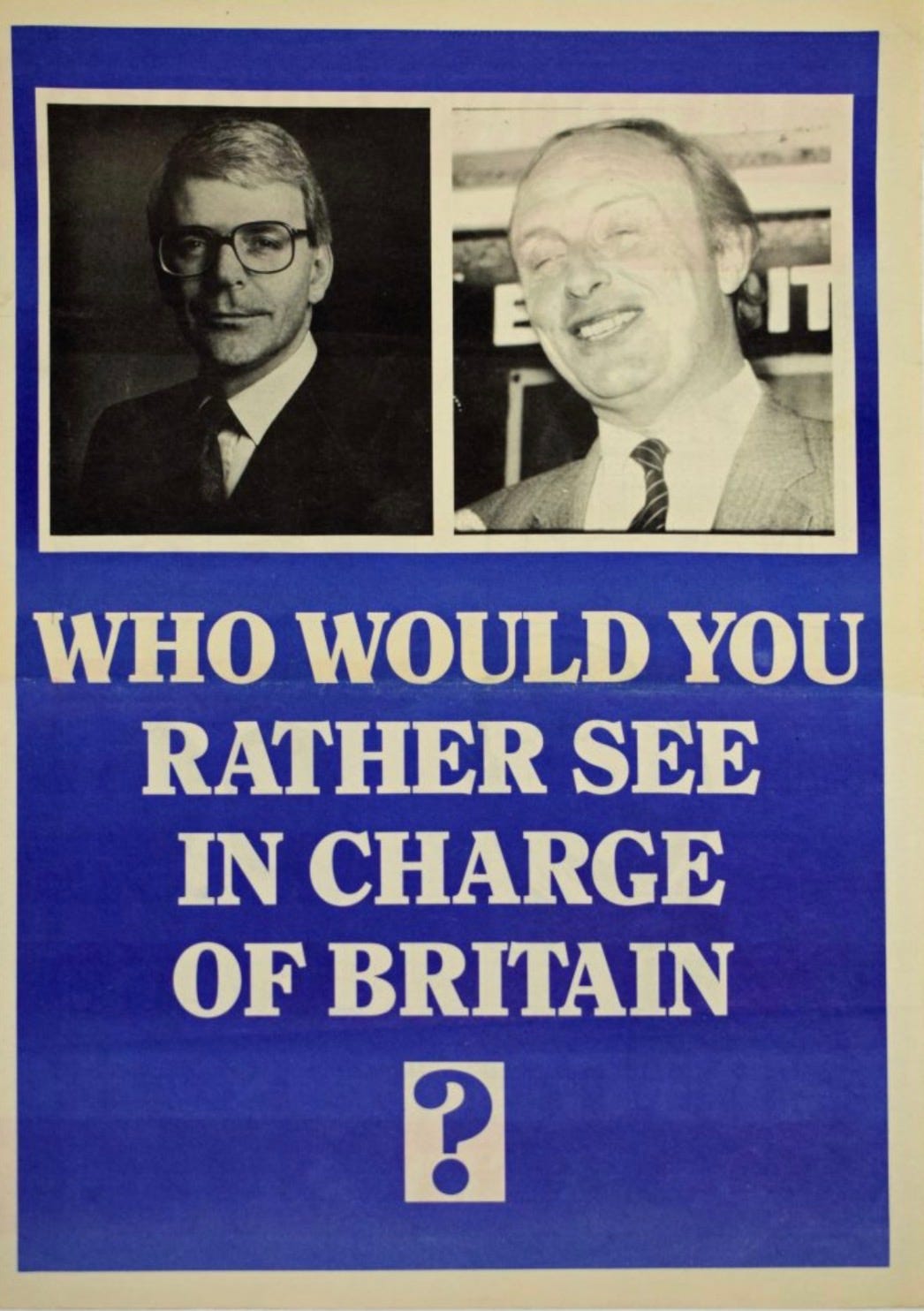
A few weeks later my manager at Waterstones sent me round the party offices to collect posters and rosettes for a display on the manifestos. The Labour campaign was in the NUR building in Millfield, which is the part of Peterborough where working people actually lived. The door was open and I walked straight in. The Conservative office was closer to town, a house converted into an office, cameras on the exterior, an intercom by the door. Mawhinney was a Minister of State for Northern Ireland by then. The security made a kind of sense. The contrast with the open door in Millfield made a different kind of sense. I do not remember the Liberal Democrats, though they must have had an office somewhere. Ashdown was leading them to their best result in years. Perhaps the visit left no impression. Perhaps I never made it.
That was my political education in miniature. Who has your address before you have voted once. Which offices have intercoms and which have open doors. What the apparatus of a political party looks like when it is confident of its territory, and what it looks like when it is fighting for its people. Somewhere in between, at some point in those weeks, a pollster rang the hall phone and asked me questions about voting intention sandwiched between questions about washing powder or margarine. I answered because nobody’s tea was ready and Coronation Street wasn’t on. The spontaneity of it was the point. You were reached before you could construct a reason not to engage.
Stanley Greenberg has been reading British electorates since around that time. He was Bill Clinton’s pollster. Then Tony Blair’s. The centre-left’s understanding of what voters think and want has run through his firm for a generation. His methodology is serious, his data is real, and the report he has produced with UCL’s Policy Lab, published this morning on local election day, contains findings that should embarrass the Labour government. Mobile phones have killed the random call. You register online now, opt into a panel, self-select into the sample. The people who answer Greenberg’s questions are not the people my mother was when she picked up that hall phone, or the person I was. They are people who have already decided they have opinions worth recording.
That is not quite the argument. The methodology is not the problem. Greenberg’s instrument does what it is designed to do, and it does it well. The problem is what the instrument has decided, before a single question is asked, constitutes the political landscape worth measuring.
Start with what it actually shows.
On immigration, the findings are precise and damaging. Labour’s current approach: doubling residency waiting times to ten years, forced returns after thirty months, country-level entry bans, increased deportations. It gets a warm response from existing Labour voters and almost nobody else. Among those considering returning to Labour, net negative. Among 2024 defectors, net negative. Among Red Wall voters who left, net negative. Among Green voters, sharply negative. The policy was apparently designed to compete with Reform on the nationalist right. Only one percent of Reform voters say there is a fair chance they could back Labour regardless of what Labour does on immigration. Labour built a trap, chose to walk into it, and is now bleeding inside it.
The report tests an alternative. Legal, vetted refugee quotas. Asylum hotel savings redirected to fund integration. A France deal built around channel policing. This gets close to seventy percent warm response among Labour voters, near sixty percent among defectors and Blue Wall voters. The contrast is not marginal. It is the difference between a policy that works politically and one that does not, and Labour chose the one that does not.
Why? Because Labour made a calculation about where the threat was coming from, and the calculation was wrong. The voters Labour lost to Reform were not primarily persuadable back through deportation rhetoric. They were people who wanted something different and found, in the Greens and the abstention column, a way to say so. Chasing Reform meant abandoning them. The data in this report makes that plain.
Which is where the report’s deeper problem begins.
Greenberg treats Reform UK as the terminal point of the British nationalist right. His thermometer scale measures attitudes toward Reform. His narrative testing records where Reform’s policies find purchase. He notes, usefully, that Reform appears to be reaching its ceiling. Conservative voters are not crossing to Farage in the numbers he needs. The right-hand boundary of the report’s political universe is Nigel Farage. Past that boundary, the instrument records nothing.
Restore Britain does not appear in this document. Not once.
Rupert Lowe is a single MP, kicked out of Reform, running a party most people have not heard of. That is precisely the point. On the day this report was published, his party, registered with the Electoral Commission in time to contest today’s local elections, is running candidates on a programme that makes Reform’s immigration slogans look like back-of-envelope arithmetic. The deportation paper runs to 133 pages. The policy on mosque closures is stated as day-one government action. The death penalty referendum for what the party calls Islamist child murderers is not a thought experiment. These positions are published, amplified, and defended by Restore Britain’s own senior figures, in their own words, on their own accounts. Nobody in the polling industry is measuring them because nobody in the polling industry considers them worth measuring yet.
Those figures are not abstractions. Charlie Downes, Restore Britain’s campaigns director and spokesperson, posts programmes of mass deportation beneath photographs of a white 1950s Britain that never quite existed. Stating the ideology plainly, not gesturing toward it. Lewis Brackpool, Director of Investigations, runs the vetting operation and has demanded the state ban opposition to fascism. Lowe chose these people. He built this with them. When critics point to the company he keeps, his response is contempt.
The Greenberg report cannot see any of this, because it is not looking. The instrument measures the available electorate and the parties currently competing for it. What is being organised outside that frame does not register. Temperature is recorded. What is being built in the rooms the thermometer cannot reach is not.
This matters for the immigration question directly. The report finds significant support, particularly in the Red Wall, for mass deportation as a policy preference, and records it as data about Reform’s appeal. It cannot record what Restore Britain is doing with the same sentiment: building infrastructure, policy depth, think-tank connections to the European ethnonationalist movement that has already reshaped politics from Paris to Budapest. If Reform has peaked, as the data suggests, the pressure on the British nationalist right to find new vehicles intensifies. Farage built a protest movement. Lowe is attempting to build something more durable.
The report concludes, reasonably, that Labour can recover ground through clarity on Trump, ambition on child poverty, honesty about Brexit, commitment to the green transition. The renewables argument has been strengthened, counter-intuitively, by Operation Epic Fury. The Iran war has pushed oil company unfavourability to a recorded low, and a plurality of voters still says accelerate renewables rather than expand North Sea production. These are real findings. A Labour party capable of acting on them rather than just messaging them might find something worth saying.
But the organised left is reading the same report this morning and drawing the same conclusions, and the report’s blind spot is also the left’s blind spot. The serious analytical energy is directed at Farage, at the Reform ceiling, at how Labour recovers its progressive coalition. The question of what is being built to Reform’s right is not being asked.
In 1992 I walked into an open door in Millfield and found a campaign in full swing. Across town, cameras and an intercom. The difference told you something the polls that year could not. The Greenberg report is valuable work. It tells you a great deal about where British politics is. It cannot tell you where it is going, because it has decided it already knows where the right ends.
It ends at Reform. The people campaigning for Restore Britain know otherwise.
Thanks for reading Anti-Capitalist Musings. It is a small operation, and I hope it offers something worth your time. There will be no premium subscriber content here: everything published will remain free to read. If you value these pieces and want to support the writing, buying me a coffee helps fund media subscriptions and the books that keep the analysis grounded. Every contribution, however modest, is genuinely appreciated.